Về kỹ thuật chế tác công cụ trong văn hóa Phùng Nguyên

Chiếm tỉ lệ chủ yếu trong công cụ sản xuất của cư dân văn hoá Phùng Nguyên vẫn là đồ đá. Tuy nhiên, kĩ thuật chế tác đá của cư dân Phùng Nguyên đã đạt đến đỉnh cao mà ở giai đoạn trước hay sau đó đều không vượt qua. Hầu hết các loại công cụ và đồ trang sức bằng đá của người Phùng Nguyên đều được mài nhẵn, có kích thước nhỏ nhắn, tinh tế, được chế tác từ các loại đá quí hiếm, có độ rắn cao, màu sắc đẹp. Nếu ở giai đoạn hậu kì đá mới, con người mới biết đến các loại hình kĩ thuật như ghè, đẽo, cưa, khoan, tiện đá… thì đến văn hoá Phùng Nguyên, những kĩ thuật này đã trở nên phổ biến thành thục đến độ tinh vi. Các thao tác kĩ thuật như tiện đá, khoan lỗ và khoan tách lõi đã giúp người Phùng Nguyên tạo ra các loại hình công cụ có hình dáng chính xác và tiết kiệm được nguyên liệu.

Chiếm đa số trong các loại hình công cụ đá Phùng Nguyên là các loại rìu bôn có thiết diện hình tứ giác. Người ta đã tìm thấy số lượng lớn các bôn đá hình tứ giác có lưỡi vát lệch một bên ở các di chỉ Phùng Nguyên. Ngay tại một di chỉ như Gò Bông (Phú Thọ), các nhà khảo cổ học đã tìm thấy 44 chiếc bôn đá. Phần lớn trong số bôn đá tìm được có kích thước nhỏ, mỏng, dài trung bình từ 1,8 – 2,5cm, rộng 1,5 – 2cm, dày 0,1 – 0,5cm, lưỡi tạo góc 30 – 40 độ, nhiều chiếc dài bằng chiều rộng [1].

Bện cạnh là các loại rìu đá hình tứ giác có kích thước nhỏ, góc lưỡi sắc. Đặc biệt, người ta cũng bắt gặp trong các địa điểm văn hóa Phùng Nguyên loại rìu đá được chế tác bằng ngọc Nephrit có màu trắng đục, trắng vân hồng hay vân xanh. Loại rìu này kích thước rất nhỏ (dài trung bình 3cm, rộng gần 2cm, dày 0,5cm), có loại còn bé hơn, giống như đồ trang sức của con người. Đó là sản phẩm của đôi bàn tay chế tác đá tài hoa của người Phùng Nguyên bấy giờ.

Ngoài bôn và rìu đá, trong các di chỉ Phùng Nguyên còn tìm thấy nhiều loại hình công cụ khác, như đục đá, cuốc đá, dao đá, liềm đá, cưa đá, mũi khoan đá, mũi lao, mũi giáo, mũi tên đá 2 – 3 cạnh… Những hiện vật này đều được làm ra trong một số công xưởng chế tác đá ở Tràng Kênh, Bãi Tự, Gò Chè,…

Trong một số di chỉ thuộc văn hoá Phùng Nguyên, người ta còn tìm được những cục đồng nhỏ, gỉ đồng và xỉ đồng. Tại di chỉ Gò Bông, bên cạnh những cục đồng còn tìm thấy xỉ đồng và gỉ đồng ở độ sâu 1,3m. Ở một số địa điểm khác như gò Đồng Xâu, Lũng Hoà, chùa Gio cũng tìm thấy gỉ đồng và mảnh khuôn đúc đồng bằng đất nung. Bằng phương pháp phân tích quang phổ những cục đồng tìm thấy được ở Gò Bông, người ta cho rằng đây là hợp kim đồng thau (gồm đồng, thiếc và một số vết bạc) chứ không phải là dạng đồng đỏ ban đầu.

Việc phát hiện xỉ đồng, gỉ đồng, khuôn đúc đồng bằng đất nung là bằng chứng cho phép chúng ta xác định về sự ra đời của nghề luyện kim đồng thau ở Việt Nam trong giai đoạn phôi thai.

Tuy nhiên, cho đến nay, vẫn chưa tìm thấy được những đồ đồng nguyên vẹn trong các di chỉ Phùng Nguyên. Việc không có những hiện vật bằng đồng được định hình cho thấy đồ đồng thời bấy giờ còn chiếm tỉ lệ rất ít. Không thể phủ nhận rằng, mặc dù chủ nhân của văn hóa Phùng Nguyên đã bước vào thời đại kim khí nhưng đồ đồng vẫn chưa lấn át được công cụ bằng đá. Đồ đá vẫn chiếm tỉ lệ chủ yếu (92%) và là công cụ chủ đạo trong đời sống sản xuất – kinh tế của người Phùng Nguyên [2].

Nguồn: bachkhoatrithuc.vn

Mai Pha (Lạng Sơn) – nền văn hóa mang đậm giá trị nghệ thuật đặc sắc

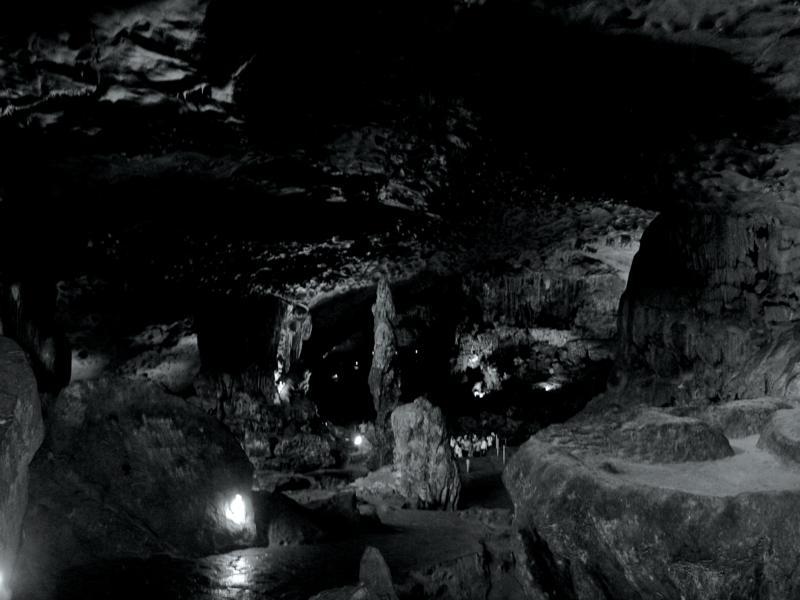
LSO-Kế thừa Văn hóa Bắc Sơn là Văn hóa Mai Pha; cư dân của văn hóa Mai Pha thuộc hậu kỳ đá mới và tồn tại trong khung niên đại từ 5000 đến 3500 năm cách ngày nay. Văn hóa Mai Pha được gọi theo tên của di chỉ hang Mai Pha, nằm trong một núi đá nhỏ đơn độc giữa thung lũng ở phía Nam xã Mai Pha, tên ngọn núi chứa di chỉ hang Mai Pha theo tiếng địa phương là núi Phjia Nùn có nghĩa là Núi Tuyết. Di chỉ này có mối liên hệ mật thiết với núi Phia Điểm (Di chỉ khảo cổ học (KCH) phía Nam thành phố Lạng Sơn đã khai quật năm 1998).
Di chỉ KCH Mai Pha đã được nhiều nhà KCH, sử học tới đây khảo sát nhiều lần. Lần đầu do ông Retíp (một chủ đồn điền trồng chè của Pháp tại Lạng Sơn vào những năm 1920 do di chỉ nằm trong khu vực đồn điền chè của ông) đã khảo sát nhẹ lớp mặt hang và đã thu thập được một số di vật bằng gốm (bát bồng chân đế cao, âu gốm,…) cùng một số công cụ bằng đá (rìu đá, mảnh tước,…). Đến những năm sau này (năm 1921; 1923) thì có hai nhà sử học và nhà địa chất học người Pháp là H.Mansuy và M.Colani cũng đã tới đây khảo sát và đào thám nhỏ lại tại hang này và cũng đã thu thập được một số công cụ đá, gốm (giống như di vật của ông Retíp đã khảo sát và thu thập trước đó). Đến năm 1995 Bảo tàng Tổng hợp tỉnh tiếp tục khảo sát và đào thám sát hang này kết quả thu được rất khả quan. Năm 1996 địa chỉ di chỉ hang Mai Pha chính thức được khai quật KCH. Sau hơn 1 tháng khai quật, kết quả thu được rất tốt gồm: 123 hiện vật bằng đá, trong đó có 70 rìu, bôn, đục, bàn mài bằng đá và 12 đồ trang sức bằng đá như: vòng tay, khuyên tai và 23 hiện vật bằng xương cùng các đồ trang sức khác. Cũng tại đây đã phát hiện được dấu tích mộ kè đá; mộ vò (loại mộ được xếp chèn xung quanh bằng những chiếc bát gốm) cùng với xương bị đốt cháy, quanh khu vực di chỉ phát hiện được 5 bếp cùng nhiều mẫu tro, than, xương, vỏ ốc bị đốt cháy,…
Qua dấu tích của bếp lửa đã thể hiện rõ cư dân Mai Pha đã biết ăn chín, uống sôi (thông qua các loại đồ đựng bằng gốm như: bát bồng, nồi miệng loe,…) cùng rất nhiều các mảnh vỡ của gốm vương vãi khắp trong di chỉ, điều đó cho thấy lúc này đã có sự xuất hiện của tiểu thủ công nghiệp và trao đổi hàng hóa.
Cư dân văn hóa Mai Pha về kỹ thuật chế tác lúc này đã phát triển và kế thừa từ cư dân văn hóa Bắc Sơn, tuy nhiên cuộc sống của họ còn rất khó khăn và nơi cư trú của họ chủ yếu vẫn là trong các hang động và mái đá. Về cộng đồng xã hội lúc này chưa phát triển, họ sống quần cư tạo thành nhóm người hoặc tập thể hay bộ lạc, cuộc sống còn ăn hang ở hốc nhưng họ đã biết cảm thụ về nghệ thuật và có một cảm nhận nhất định về nghệ thuật tạo hình và nghệ thuật trang trí. Về nghệ thuật tạo hình cư dân Mai Pha đã làm thay đổi hình dáng vật thể từ những hòn đá đơn thuần qua chế tác đã tạo thành những chiếc rìu rất đẹp như: rìu mài lưỡi, rìu tứ giác, rìu có vai,… Không những thế mà cư dân Mai Pha còn biết tạo ra một vật thể mới từ nguyên liệu có sẵn trong tự nhiên đó là đồ gốm như: nồi, âu, bình, bát,… (đặc biệt là bát bồng chân đế cao). Chất liệu chủ yếu của gốm văn hóa Mai Pha là khá phổ biến và phong phú, hầu hết đều được làm từ đất sét. Đa số gốm văn hóa Mai Pha có màu gạch đỏ, một số có màu đen (do ám khói khi nung hoặc đun nấu) cũng có một số mảnh đen bóng có lẽ do được tạo bởi một loại nhựa từ vỏ cây hoặc một chất keo nào đó. Phần lớn chân đế của gốm Mai Pha là được trang trí nhiều nhất, còn phần thân thì chỉ được trang trí nhẹ như văn thừng trải, văn thừng mịn và văn thừng thô, cũng có loại để trơn không trang trí. Gốm khắc vạch kết hợp chỗ lỗ thủng ở chân đế bát bồng là nét nổi bật nhất trong nghệ thuật chạm khắc và trang trí của gốm Mai Pha. Ngoài việc trang trí hoa văn trên gốm Mai Pha, cư dân văn hóa Mai Pha còn biết chế tác các đồ dùng, đồ trang sức, công cụ lao động sản xuất và vũ khí từ nhiều chất liệu khác nhau như: đá, xương, mảnh vỏ trai,…
Thông qua nền văn hóa Mai Pha và những hiện vật, di vật thu thập được tại di chỉ Mai Pha có thể khẳng định người tiền sử Mai Pha đã có những cảm nhận về mỹ thuật từ rất sớm, từ mỹ thuật chạm khắc cho đến mỹ thuật tạo hình. Họ đã biết tạo tác ra các loại công cụ sản xuất, đồ trang sức,… bằng đủ mọi chất liệu đạt được đến trình độ cao. Đồng thời họ đã biết bảo lưu và sáng tạo những họa tiết, hoa văn trên đồ dùng và chế tác ra những công cụ, đồ trang sức đẹp hơn, thẩm mỹ hơn.
Nguồn: http://baolangson.vn/tin-bai/Van-hoa-xa-hoi/van-hoa-mai-pha-nen-van-hoa-mang-dam-gia-tri-van-hoa–nghe-thuat-dac-sac/30-30-25692; covatvietnam.info chỉnh sửa

Bàu Tró – di chỉ truyền kỳ

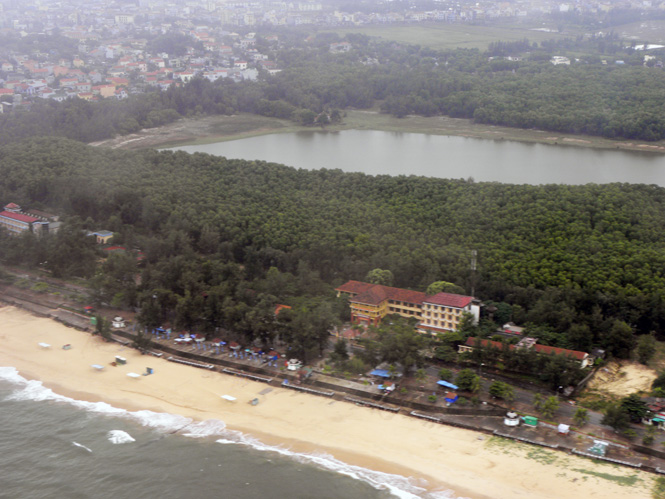
(QBĐT) – Nằm gọn giữa lòng động cát cao sát phía bắc cửa biển Nhật Lệ, Bàu Tró có phong cảnh hữu tình, tĩnh lặng,… Không chỉ là hồ nước ngọt cung cấp nguồn nước sạch cho nhân dân thành phố Đồng Hới bấy lâu, Bàu Tró còn là nơi tồn tại những dấu tích cư trú và sinh sống của người nguyên thủy thời hậu kỳ đồ đá. Với ý nghĩa khoa học to lớn của Bàu Tró, các nhà nghiên cứu đã lấy tên di chỉ này để đặt tên cho một loại hình văn hóa tiêu biểu của  miền Trung, đó là “Văn hóa Bàu Tró”.

Bàu Tró (thuộc địa phận phường Hải Thành, thành phố Đồng Hới ngày nay) tương truyền là bàu nước ngọt sạch nhất, sạch hơn nước giếng của người dân trong vùng. Khi chưa có nhà máy nước, người dân Đồng Hới thường uống nước Bảo Ninh chở sang. Nơi đây hoang vắng, chưa có dân cư và là nơi có miếu Long Vương, thờ thần Hà Bá nổi tiếng linh thiêng, hồ được giữ sạch sẽ, người dân chỉ đến đây lấy nước về dùng vào việc cúng giỗ chứ ít khi lấy nước Bàu Tró về dùng hàng ngày. Hiện nay, Bàu Tró không còn cảnh hoang vu, từ những động cát làm thành trì cho hồ đã có một phường dân cư sinh sống.

Mùa hè năm 1923, nhà khảo cổ học người Pháp Etienne Pette đã đến Bàu Tró khai quật một gò cát cạnh hồ và đã phát hiện có dấu vết của người xưa. Và tên gọi: Bàu Tró, một di chỉ của người Việt cổ cũng bắt nguồn từ đó. Nhà khảo cổ học Etienne Pette đã khẳng định người nguyên thủy đã đến cư trú quanh hồ Bàu Tró từ ngàn xưa và đã để lại dấu tích từ trong lòng cát. Những hiện vật thu được từ di chỉ khảo cổ học này hiện còn lưu trữ tại Viện Bảo tàng lịch sử Việt Nam gồm: 46 rìu đá, 140 mảnh tước, 2 hòn đá bằng thạch anh, 1 dụng cụ đá dùng để ép, 14 bàn nghiền hạt, 1 chì lưới, một đốt xương sống cá và vỏ sò, mảnh gốm…

Nhà khảo cổ cho rằng người tiền sử đã để lại các dụng cụ và rất nhiều vỏ ốc là di tích các bữa ăn của họ. Khi nền văn hóa của người nguyên thủy đã chuyển xuống ven biển, ven sông có nghĩa là họ không còn thích nghi ở trong hang động nữa. Nền văn hóa đồ đá mới phân bố khắp nơi trên đất Quảng Bình, từ bắc vào nam, từ núi rừng xuống đồng bằng. Di chỉ Bàu Tró còn khẳng định thêm một điều bí ẩn là ở thời hậu kỳ đồ đá mới, người tiền sử Bàu Tró rất thạo nghề đánh cá biển và việc tìm thấy những mũi tên bằng xương cá chứng tỏ nghề săn bắn lúc này cũng khá phát triển.

Toàn cảnh Bàu Tró nhìn từ trên cao.

Cũng tại Bàu Tró, mùa xuân năm 1980, Khoa Khảo cổ Trường đại học Tổng hợp Huế (nay là Trường đại học Khoa học Huế) lại khai quật di chỉ này một lần nữa. Địa điểm khai quật nằm phía tây nam Bàu Tró, cách hố khai quật của nhà khảo cổ học Etienne Pette hơn 100m về phía tây. Hiện vật thu được gồm: 31 rìu bôn đá, 17 bàn mài, 7 chày nghiền, 3 mũi nhọn, 1 vòng, 2 phiến tước, nhiều cục thổ hoàng bị mài vẹt từ nhiều phía, 11.972 mảnh vỡ đồ gốm của nồi, niêu, bình, vò, bát, đĩa… được trang trí bằng hoa văn đấu thừng, hoa văn khắc vạch có màu đỏ, màu đen ánh chì. Và điều vô cùng lý thú là nếu năm 1923, nhà khảo cổ  Etienne Pette chỉ tìm thấy loại di chỉ cồn Cò Điệp thì nay Khoa Khảo cổ Trường đại học Tổng hợp Huế tìm thấy loại di chỉ mới đó là di chỉ Cồn Đất tại Bàu Tró. Với ý nghĩa khoa học to lớn của di chỉ Bàu Tró, các nhà nghiên cứu đã lấy tên này để đặt tên cho nền văn hóa hậu kỳ đá mới, gồm các di chỉ phân bố vùng ven biển Nghệ – Tĩnh, Quảng Bình, Quảng Trị, Thừa Thiên Huế là “Văn hóa Bàu Tró”.

Cũng có nhiều ý kiến cho rằng, Văn hóa Bàu Tró là nền văn hóa tiêu biểu của miền Trung, là một trong những cội nguồn nảy sinh văn hóa Đông Sơn phía Bắc và văn hóa Sa Huỳnh ở phía Nam. Điều này còn chứng tỏ cư dân tiền sử Quảng Bình có sự giao lưu vùng rộng lớn từ Bắc đến Nam Trung bộ, phát triển liên tục từ thời kỳ đồ đá đến đồ đồng, đồ sắt.

Xung quanh 2 từ Bàu Tró, cho đến nay vẫn là một vấn đề bàn cãi chưa ngã ngũ về ngôn ngữ và lịch sử. Các nhà khảo cổ học đã phát hiện Bàu Tró là di chỉ giàu về đồ gốm và giỏi về nghề gốm, nhưng các nhà ngôn ngữ học thì đoán định Bàu Tró là bàu lúa. Thêm nữa, theo truyện kể trong dân gian Đồng Hới thì Bàu Tró rất sâu, sâu không có đáy vì có người đã thử bơi bè ra giữa lòng hồ, rồi buộc đá vào dây thả xuống đo chiều sâu nhưng thả mấy cũng không thấy dây chùng lại. Lại có chuyện ly kỳ khó tin rằng, sau một trận lũ rất lớn, khi nước rút xuống có người đã lượm được những quả bưởi của vùng Trốôc Vực (Lệ Thủy) tại hai bên bờ Bàu Tró. Câu chuyện Bàu Tró đáy ngầm thông với Trôốc Vực cũng bắt nguồn từ đó.

Cùng với những di chỉ và truyền kỳ, Bàu Tró nay được Nhà máy cấp nước Đồng Hới quản lý (trực thuộc Công ty TNHH MTV Cấp thoát nước Quảng Bình) có công suất thiết kế cung cấp 9.000 m3 nước/ngày đêm. Hồ Bàu Tró cùng với hồ Phú Vinh cung cấp nước sinh hoạt cho nhân dân TP.Đồng Hới và một số xã, thị trấn của huyện Quảng Ninh. Tuy nhiên, từ năm 2003 đến nay, hồ Bàu Tró chỉ được khai thác cầm chừng với công suất 3.000m3 nước/ngày đêm (phục vụ cung cấp nước sinh hoạt cho khoảng 20% dân cư TP.Đồng Hới, số còn lại đều lấy nước từ hồ Phú Vinh).

Theo ông Nguyễn Văn Dũng, Trưởng phòng Kế hoạch-Kỹ thuật, Công ty TNHH MTV Cấp thoát nước Quảng Bình cho biết: Sở dĩ Công ty chỉ khai thác với công suất cầm chừng như vậy là để bảo vệ Bàu Tró, di chỉ của người Việt cổ. Hồ Bàu Tró nằm sát biển, chất lượng nguồn nước có giảm so với trước đây do ô nhiễm môi trường từ quá trình đô thị hóa. Nếu khai thác hết công suất thì khả năng xâm nhập nước mặn vào hồ rất cao. Hiện tại, công nhân vận hành trạm bơm nước Bàu Tró vẫn thường xuyên theo dõi sự biến động của mực nước trong hồ để điều chỉnh chế độ khai thác hợp lý.

Cho dù là những di chỉ với những câu chuyện kỳ bí hay là hồ nước ngọt hàng ngày cung cấp nước sinh hoạt cho nhân dân TP. Đồng Hới thì Bàu Tró vẫn là địa danh có ý nghĩa đặc biệt quan trọng, rất cần được bảo vệ một cách khoa học trước nguy cơ bị ô nhiễm ngày càng tăng trong tiến trình đô thị hóa hiện nay.

Nguồn: http://baoquangbinh.vn/dat-va-nguoi-quang-binh/201402/bau-tro-di-chi-truyen-ky-2113039/

Văn hóa Bàu Tró (Quảng Bình)

Văn hoá Bàu Tró thuộc thời đại đồ đá mới, cách ngày nay khoảng 5.000 – 4.500 năm. Hơn 20 di tích thuộc văn hoá Bàu Tró đã được phát hiện và nghiên cứu, chúng là những di tích cồn sò, cồn cát, cồn đất, phân bố dọc ven biển các tỉnh Nghệ An, Hà Tĩnh và Quảng Bình.

Hiện vật đá bao gồm rìu, bôn, cuốc, dao, dao cưa, mũi khoan, chày, bàn nghiền, hòn ghè, bàn mài, giáo, đồ trang sức, phác vật và mảnh tước. Đặc biệt rìu, bôn, cuốc là những công cụ sản xuất quan trọng nhất đều được mài toàn thân và rìu bôn có vai là công cụ đá tiêu biểu nhất của văn hoá Bàu Tró. Đây là đặc trưng quan trọng phân biệt giữa văn hoá Bàu Tró với các văn hoá đá mới khác.

Ngoài hiện vật đá, đồ gốm khá phong phú và đa dạng, bao gồm 3 loại khác nhau: gốm đáy nhọn văn chải 2 mặt, gốm đáy tròn văn thừng, gốm đáy tròn hoặc có chân đế trang trí văn khắc vạch trên nền thừng kết hợp với tô màu đỏ. Nhìn chung, văn hoá Bàu Tró đã đạt đến trình độ chế tác đá cao và làm gốm bằng bàn xoay, kiếm sống bằng thu lượm, săn bắn (bắt), đánh cá, làm nông nghiệp và chăn nuôi.

Văn hoá Bàu Tró phát sinh từ văn hoá Quỳnh Văn lên, người Bàu Tró cũng đã mở rộng giao lưu với người Hạ Long và Hoa Lộc ở phía Bắc, với cư dân Xóm Cồn ở phía Nam và với cư dân Tây Nghệ An và Quảng Bình.

Nguồn: http://baotangnhanhoc.org/vi/gioi-thieu/suu-tap-hien-vat-va-mau-vat/37-vn-hoa-bau-tro.html

Văn hóa Hạ Long giai đoạn hậu kỳ đồ đá mới

Nổi tiếng là một trong những nền văn hóa tiền sử được biết đến sớm nhất ở Việt Nam và Đông Nam Á, văn hóa Hạ Long đã được các nhà khảo cổ và địa chất học tìm ra và đặt tên từ những năm 1930.


Học giả người Thụy Điển J.G. Anderson đã nghiên cứu nhiều hang động trên quần đảo Bái Tử Long và tổng kết bằng công trình được công bố trên tạp chí Bảo tàng cổ vật Viễn Đông với tên gọi: Nghiên cứu khảo cổ học trên vùng quần đảo Bái Tử Long. Ông đã tìm thấy một số địa điểm thời tiền sử có dấu vết của con người và nhiều công cụ. Ông chọn một trong số đó để khai quật và đặt tên là Danh Do La. Đây là địa điểm văn hóa Hạ Long đầu tiên được khai quật và nền văn hóa mang tên vịnh biển đẹp nhất nước ta cũng nổi danh từ đó.

Lần theo bước chân của Anderson, các nhà khảo cổ Việt Nam biết được Danh Do La chính là địa điểm khảo cổ Ngọc Vừng, nằm trên đảo Ngọc Vừng thuộc huyện đảo Vân Đồn, cách cảng tàu du lịch Bãi Cháy khoảng 34 km. Ngày nay, du khách đến đảo hết sức thuận tiện. Trên đảo không những là nơi cách đây gần 4000 năm con người tiền sử đã cư trú mà còn có các di tích lịch sử như một trong những bến cảng xưa sầm uất của hệ thống thương cảng Vân Đồn buôn bán khắp một vùng Đông Bắc Việt Nam, nam Trung Quốc, các nước Đông Nam Á cổ đại và miền Tây Ấn Độ, di tích thành nhà Mạc, nhà Nguyễn. Người tiền sử chọn Ngọc Vừng là nơi cư trú phải chăng còn do sơn thủy hữu tình: có núi Vạn Xuân, có bãi cát trắng chạy dài hàng cây số. Cư dân trên đảo còn có nghề mò ngọc trai lâu đời, nên tên đảo cũng là Ngọc Vừng (đảo ngọc bừng sáng). Nghề mò ngọc trai giờ đã hiếm gặp nhưng du khách có thể tham quan những cơ sở nuôi trai lấy ngọc ngay trên đảo.

Bà M.Colani, nhà nữ khảo cổ người Pháp cũng gắn bó với văn hóa Hạ Long. Bà đã công bố tác phẩm “Những phát hiện thời tiền sử ở Hạ Long” đăng trong tạp chí của Viện nghiên cứu nhân học Đông Dương từ năm 1938.

Kể từ những phát hiện đầu tiên của các học giả Phương Tây đến nay đã hơn 70 năm, việc nghiên cứu về văn hóa Hạ Long từ một nhóm di tích nay đã nghiên cứu và khai quật được hơn 30 di tích. Bức tranh toàn cảnh của nền văn hóa này đã được dựng lại khá đầy đủ.

Văn hóa Hạ Long có niên đại vào khoảng 4000 – 3500 năm trước và được các nhà khảo cổ học xếp vào giai đoạn hậu kỳ thời đại đồ đá mới. Người tiền sử đã chọn một vùng biển đảo Đông Bắc Việt Nam làm nơi cư trú, nơi có một nguồn thức ăn hải sản vô tận, lại có cả bãi biển và hang động làm nơi ở thuận tiện. Địa bàn cư trú của người cổ Hạ Long là một vùng biển nông, độ sâu trung bình khoảng 10 mét, có tới 20 luồng lạch từ vùng vịnh thông ra đại dương, thuận tiện cho việc tránh gió và ra khơi đánh bắt xa bờ. Các nhà khảo cổ đã tìm được trong tầng văn hóa có những xương cá to, có thể họ đã bắt được cá nặng hàng tạ. Họ còn biết đánh cá bằng lưới mà hiện vật còn lại là những hòn chì lưới to. Ngoài cá, nhiều loại hải sản khác cũng được khai thác, nhiều vỏ nhuyễn thể còn được tìm thấy.

Công cụ đá được sử dụng trong văn hóa Hạ Long

Không những đi biển giỏi, người Hạ Long cũng là người biết làm nông nghiệp. Bằng chứng là các công cụ đá như cuốc, rìu, bôn đã có mặt. Họ tự chế tác công cụ đá bằng các kỹ thuật mài, cưa, khoan, đánh bóng,… Họ cũng đã biết làm đồ gốm bằng cách nhào đất với vỏ nhuyễn thể giã nhỏ và nung lên, làm đẹp thêm cho gốm bằng cách khắc vẽ các hoa văn hình học. Nghề trồng cây lấy sợi để đan lưới cũng là nghề thủ công phổ biến. Nghề mộc khá phát triển cùng với việc đóng thuyền bè đi biển. Việc phát hiện ra đồ gốm và tầng văn hóa dày dặn đã chứng minh họ đã là những người định cư lâu dài và đã lập làng xóm.

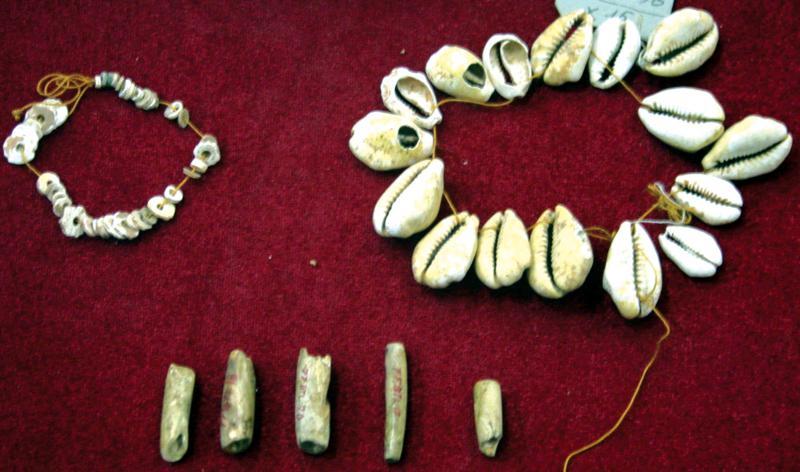
Người cổ Hạ Long còn biết tự làm đẹp. Họ ưa chế tạo đồ trang sức từ vỏ ốc biển như vỏ ốc cypraea, được mài thủng lưng để xâu dây đeo quanh cổ, dùng xương sống cá và vỏ nhuyễn thể làm hạt chuỗi, vòng tay. Họ cũng làm vòng đeo tay bằng cách khoan, tiện, mài những cục đá. Những mũi khoan đá tìm được khá nhiều đã nói lên cách làm vòng tay công phu. Những bàn mài ở văn hóa Hạ Long có những nét riêng biệt khi để lại bề mặt dấu vết mài hình lòng máng mà các nhà khoa học thường gọi là “dấu Hạ Long”, đặc trưng ít gặp ở các nền văn hóa khác.

Đồ trang sức bằng vỏ sò

Các nhà khảo cổ học cũng đã tìm được di cốt của chính chủ nhân văn hóa Hạ Long. Các xương cốt cho thấy họ thuộc đại chủng Mongoloid da vàng, nhưng vẫn còn có yếu tố Australoid hòa trộn. Chính những tộc người cổ của Hạ Long đã góp một phần vào sự hình thành của dân tộc Việt hiện đại ngày nay. Trước khi người Hạ Long sinh sống nơi đây, trên vùng biển Đông Bắc nước ta đã có cư dân của các nền văn hóa sớm hơn sinh tụ như nền văn hóa Soi Nhụ, Cái Bèo.

Ngày nay, du khách trong và ngoài nước có thể đến vịnh Hạ Long, vịnh Bái Tử Long và nhiều hòn đảo khác để nghe về một vùng truyền thuyết về Rồng (một trong 4 con vật tứ linh trong tâm thức người Việt) đã từng bay xuống mảnh đất này. Họ cũng thấy được trong cảnh sắc nước non của một địa danh di sản thế giới và đến thăm các địa điểm khảo cổ thuộc văn hóa Hạ Long còn để lại ngay trong hang động và lòng đất của các đảo, tận mắt chứng kiến các di vật còn nằm trong hơn 30 di tích, phần lớn tập trung quanh thành phố Hạ Long và khu du lịch Tuần Châu nổi tiếng.

Điểm kết của chuyến du ngoạn vịnh Hạ Long, có một địa chỉ cần dừng lại lâu hơn, chính là nhà Bảo tàng tổng hợp tỉnh Quảng Ninh, nơi trưng bày khá đầy đủ hiện vật của văn hóa Hạ Long. Bảo tàng ở ngay trung tâm thành phố Hạ Long, khá tiện lợi cho du khách tham quan.

Nguồn: http://www.vntravellive.com/news/van-hoa-ha-long-giai-doan-hau-ky-thoi-dai-do-da-moi-1072.html

The John Menke Collection of Vietnamese Ceramics @ Zetterquist Galleries

The John Menke Collection of Vietnamese Ceramics @ Zetterquist Galleries

Menke55

Four Island Plate, Vietnam, Lê Dynasty,16th century. Courtesy Zetterquist Galleries

Large Blue and White Barbed Rim Plate with underglaze cobalt blue depiction of four islands in the sea, surrounded by a band of petal designs and the cavetto of the bowl covered in  large lotus petal depictions with beautifully painted ruyi patterns within.  The mouth rim is decorated with another band of cloud decoration.  Diameter: 32.5cm.  Areas of rim fritting.

Published in “Vietnamese Ceramics: A Separate Tradition” by John Stevenson and John Guy, 1997.  Plate 244.

The John Menke Collection of Vietnamese Ceramics will be on view atZetterquist Galleries, 3 East 66th Street, Suite 1B. The encyclopedic collection from the Dong Son Culture (700-43 B.C.) through the 17th century was assembled over more than 40 years by the eminent scientist, John Menke. Zetterquist Galleries has selected more than 50 pieces for their historical importance and beauty and will offer a rare opportunity to view together 17 centuries of the Vietnamese ceramic tradition. Many of the works in this exhibition have been published in major Vietnamese ceramics books in the U.S. and Europe over the last two decades.

For over forty years, the eminent scientist John Menke assembled an encyclopedic collection of Vietnamese ceramics from the Dong Son culture (700 – 43 B.C.) through the seventeenth century.  More than fifty pieces were chosen for their historical importance and beauty, and they offer a rare opportunity to view seventeen centuries of the Vietnamese ceramic tradition in one group.  Many of the works in this exhibition have been published in major Vietnamese ceramics books in the United States and Europe over the last two decades.  The earliest pieces are earthenware vessels, some simple in their functional form, others crafted after bronze vessel shapes.  The most notable from this group is a Dong Son tripod jar with handle and impressed decoration containing original red paint.

0_

Dong Son Culture Tripod Vessel with Handle, incised pattern encrusted with red pigment. Courtesy Zetterquist Galleries

Excellent condition.  Height: 20cm
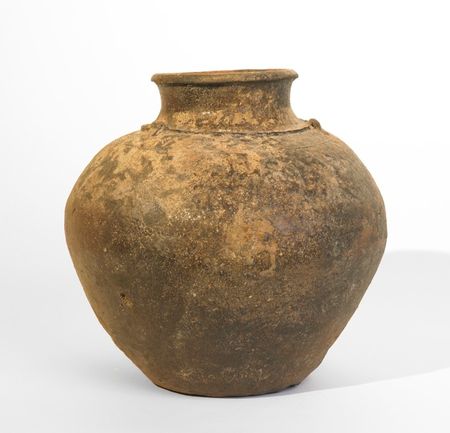
02

Early Cham Jar, brown stoneware with natural ash glaze and incised design and applied handles. Courtesy Zetterquist Galleries

Height: 18cm
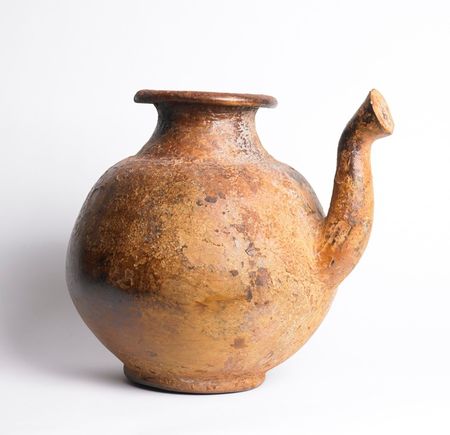
03

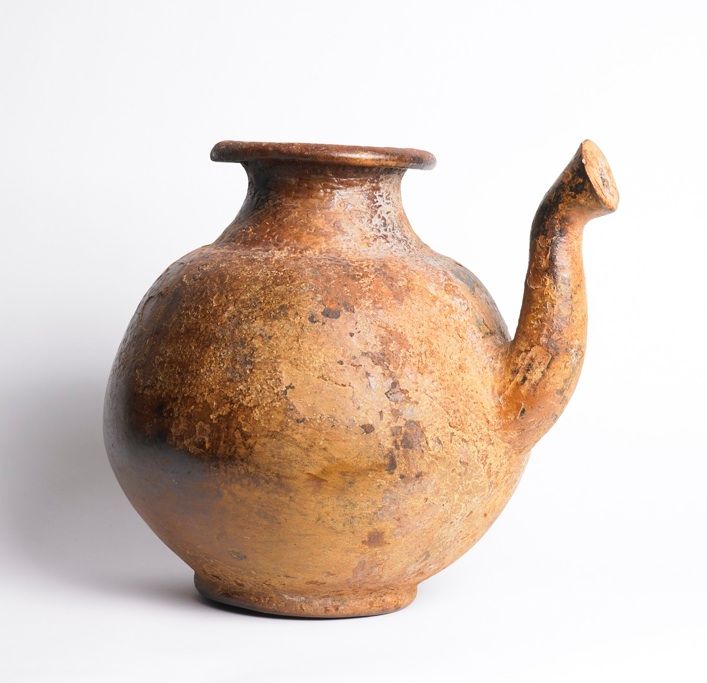
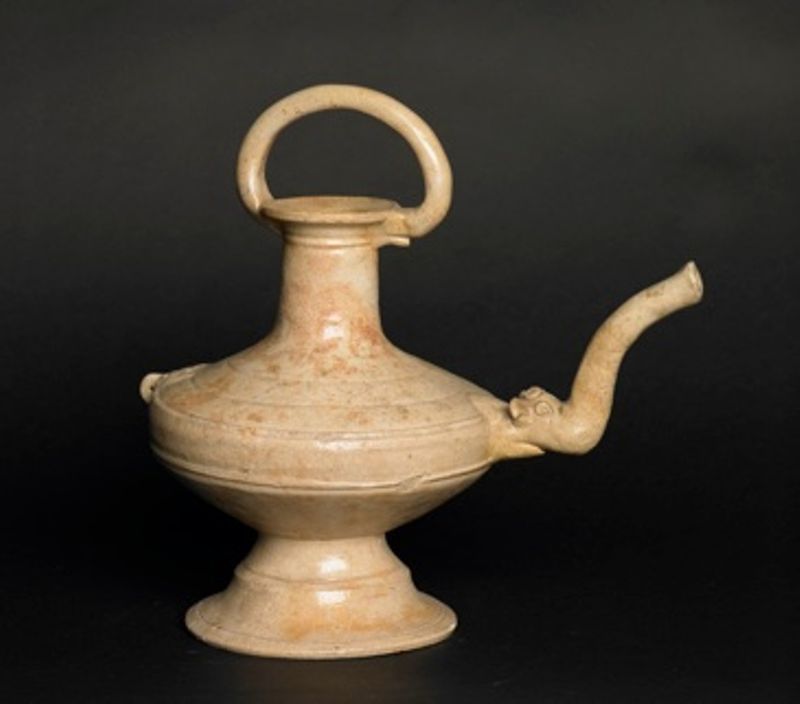
Large brown and gold ewer with elephant trunk shaped spout, Funan-Chenla Culture, 6th – 8th c. A.D. Courtesy Zetterquist Galleries

height 31cm, some repair to mouth rim,

Provenance: Jochen May Collection, Germany

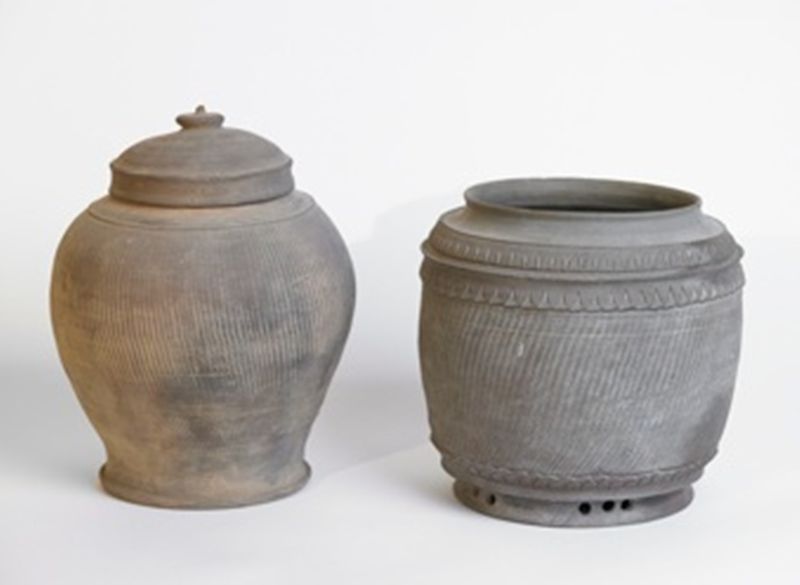
The Gioa-Chi period (44 – 544 A.D.) pieces are closely related to Chinese bronze-influenced ceramic pieces from the Han Dynasty, and they include large and important vessels of various forms, including a funerary container in the shape of a house. A large covered Hu-form jar best illustrates the direct connection Vietnam had with China during this period while retaining its own national character.
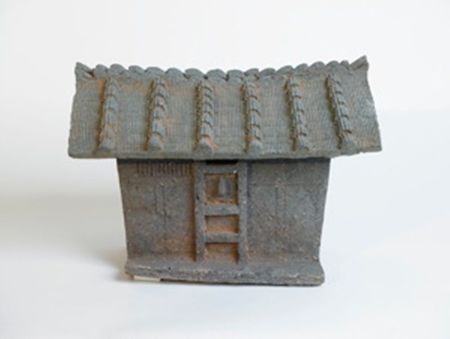
Menke6

Model of Granary, hard earthenware with incised details, In two pieces with lid as roof, Giao Chi Period from Thanh Hoa area, Courtesy Zetterquist Galleries

Height: 20.5cm Length: 29cm.  TL tested. Excellent condition.

Provenance: Jochen May Collection, Germany

Published in Verborgene Schatz; 2000 Jahre Vietnamesische Keramic, pl. 22.

05

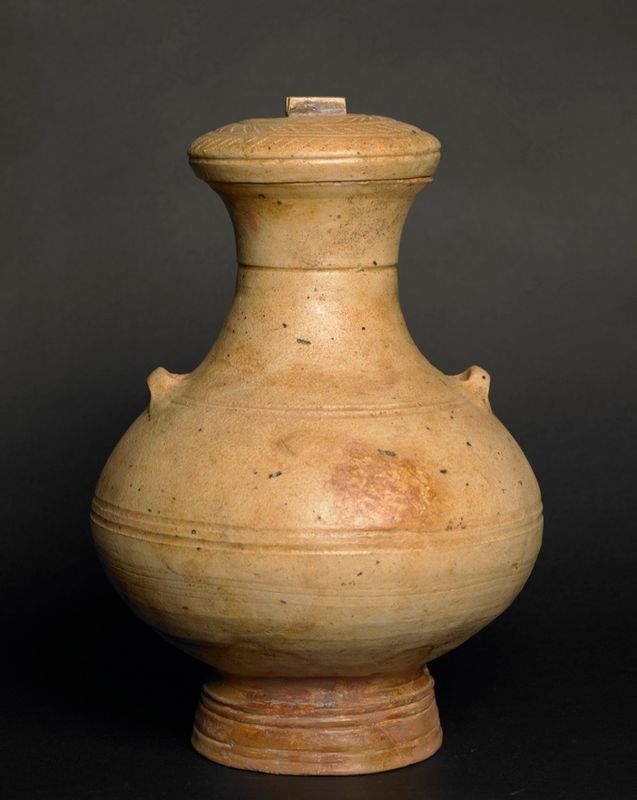
Straw Glazed Hu Shaped Jar with cover, Giao Chi Period, Incised decoration and applied handles, Courtesy Zetterquist Galleries

Height: 34cm, Repair to base,

Provenance: Jochen May Collection, Germany

Menke4

Hu Shaped Ewer with Elephant Head Spout and Totie Mask on Shoulder, buff colored stoneware, Giao Chi Period, Courtesy Zetterquist GalleriesCourtesy Zetterquist Galleries

Height: 27cm, with repair to spout and handle restored.

Provenance: Jochen May Collection, Germany,

Published in Verborgene Schatz; 2000 Jahre Vietnamesische Keramic

06

Straw Glazed Vase, Giao Chi Period, hard earthenware with incised design and applied handles. Courtesy Zetterquist Galleries

24cm high, with repaired cracks and chips.

Provenance: Jochen May Collection, Germany
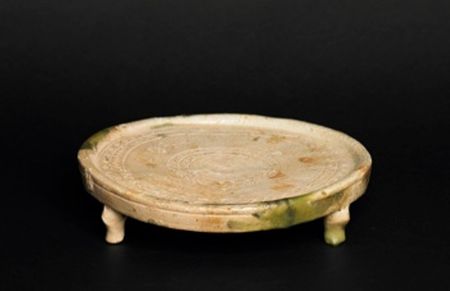
Menke9

.Tripod Tray with Green Splashes and Incised Design, Giao Chi Period, Courtesy Zetterquist Galleries

Diameter: 23cm,  some repair to rim and touch-up to green glaze.

Provenance: Jochen May Collection, Germany
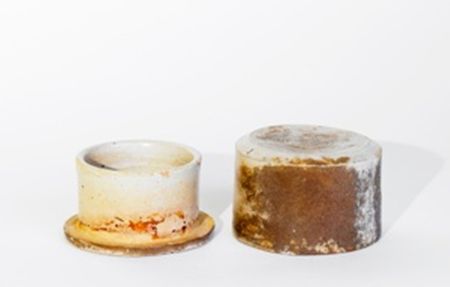
Menke5

Circular Stoneware Box with Lid, abraded  brown glaze,  Giao Chi Period, Courtesy Zetterquist Galleries

good condition,  Height: 9cm,

Provenance: Jochen May Collection, Germany

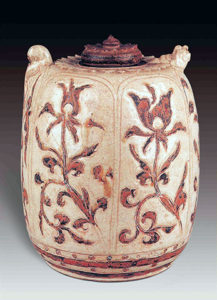
Thanh Hoa type ceramics, produced from the eleventh through thirteenth centuries, are unique in Asian ceramics, as they represent cultural influences both from India and China. Using advanced firing and glazing techniques from China, their forms were often influenced by Indian bronzes, sometimes filtered through Cambodian works, brought up through the southern trade routes.  Several different Thanh Hoa forms and types are represented in this collection, the most prominent of which is a magnificent lobed jar with its original lid and reticulated foot, all highlighted by iron-oxide brown details.
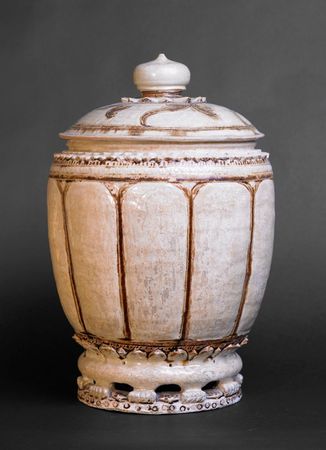
1

Large Thanh Hoa Jar with Lid.  Lobed body with brown decorative highlights and standing on a reticulated pedestal base.  Ly Dynasty. Courtesy Zetterquist Galleries

Height: 38cm.  Good condition with some areas of glaze ware and repaired cracks on lid.
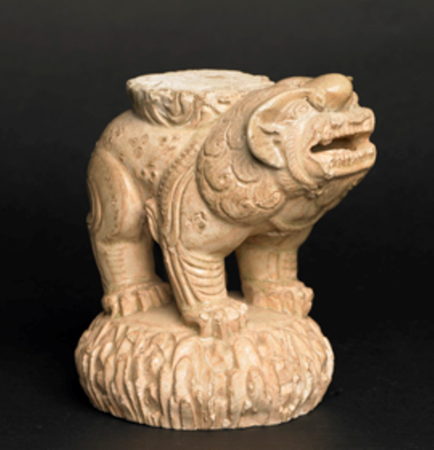
shapeimage_2

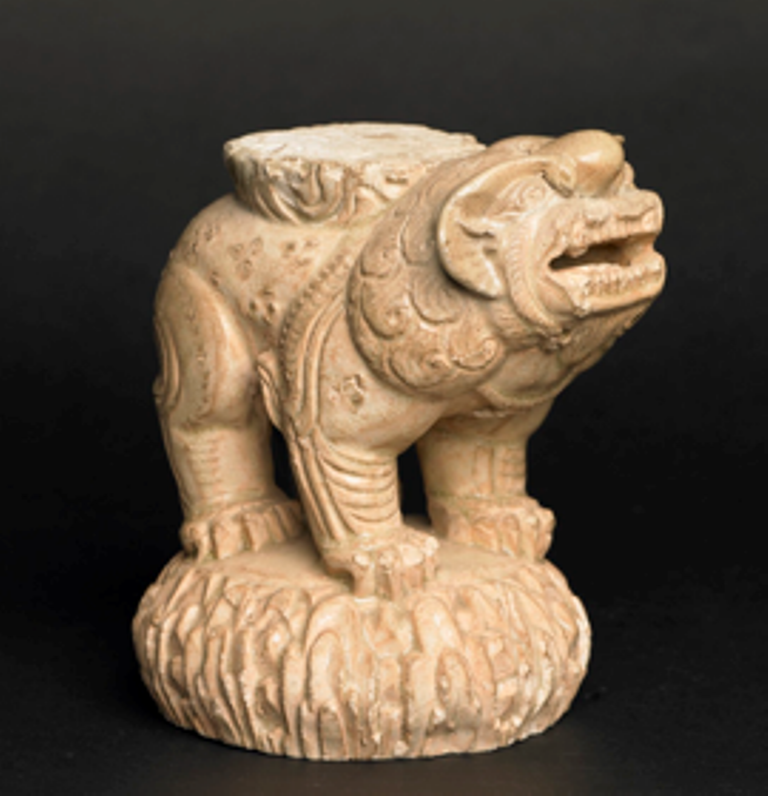
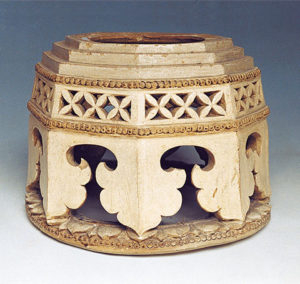
Lion Shaped Base for Lamp or Censer, straw glazed stoneware, found in Hai Duong, Ly Dynasty, Courtesy Zetterquist GalleriesCourtesy Zetterquist Galleries

Height: 15.5cm, some repair to face, chips and glaze flaking,

Provenance: Jochen May Collection, Germany,

Published in Verborgene Schatz; 2000 Jahre Vietnamesische Keramic, pl.31.
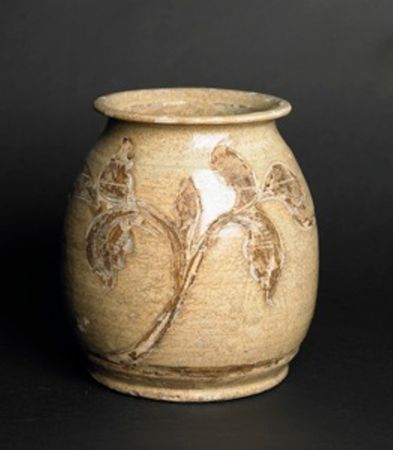
Menke15

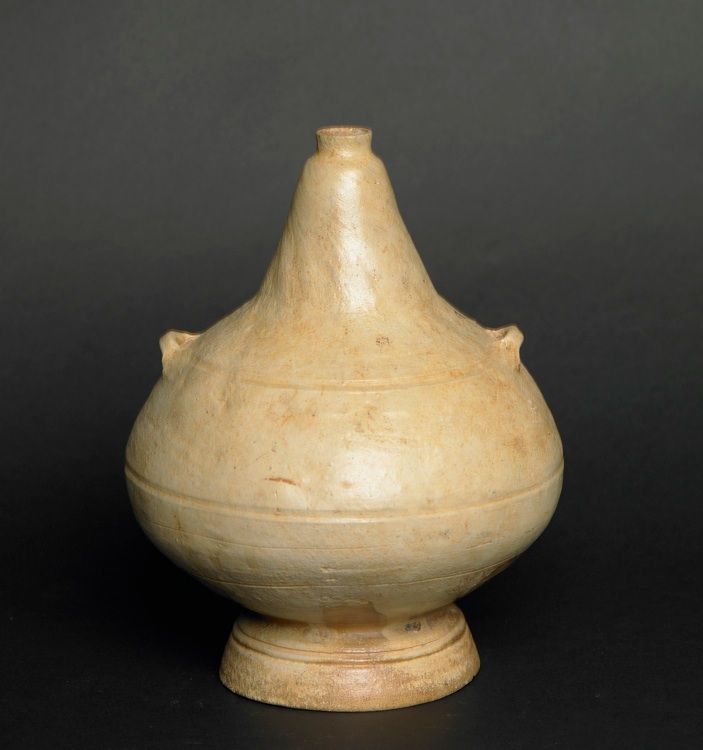
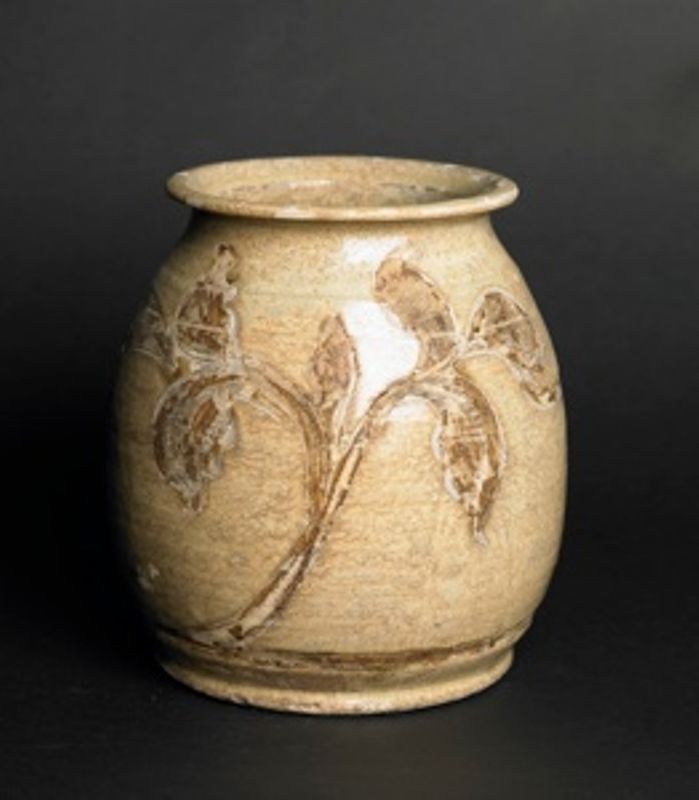
Bell-shaped Thanh Hoa Jar with Brown Floral Decoration.  Ly Dynasty. Courtesy Zetterquist Galleries

Height: 21cm. Good Condition.

Menke16_17

Thanh Hoa Bowl with Brown Dots.  Ly Dynasty. Courtesy Zetterquist Galleries

DIa. 18cm. Good Condition

Provenance: Jochen May Collection, Germany

Thanh Hoa Basin with Brown Floral Decoration.  Ly Dynasty.

Diameter: 19.5cm.  Good condition
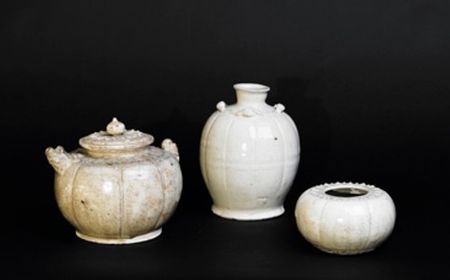
Menke11_13

Small Thanh Hoa Ewer and Cover, clear crackled glaze over white stoneware body. Ly Dynasty. Courtesy Zetterquist Galleries

Height with lid: 12cm.  Discolored and areas of glaze flaking.

Published in “Vietnamese Ceramics: A Separate Tradition” by John Stevenson and John Guy, 1997.  Plate 54

Small Thanh Hoa bottle vase with clear glaze over white stoneware body.   Ly Dynasty.

Height: 13.5cm.  Chip on mouth-rim.

Small Thanh Hoa Jar.  Clear glaze over white stoneware.  Ly Dynasty.

Height: 5.5cm.  Good condition

Provenance: Jochen May Collection, Germany

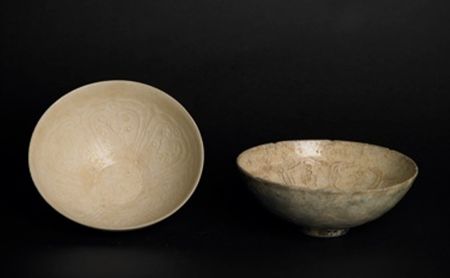
The thirteenth through fifteenth centuries saw a flourishing of ceramic production influenced by Chinese Song and Yuan Dynasty wares.  In the Menke collection, there are several forms and glaze types represented, including Qingbai-type wares, green celadons, brown wares and creamy white wares.  One of the most important of these is a large white-ware jar with raised floral decoration scrolling around its body. 

Menke25

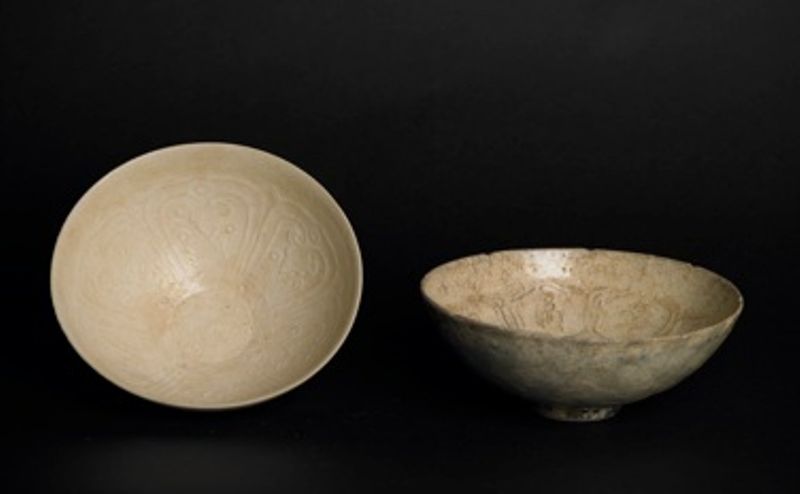
Qingbai – style bowl with molded floral decoration and a finely crackled translucent glaze.  Trân Dynasty. Courtesy Zetterquist Galleries

Diameter: 22.5cm .  Good condition.

Provenance: Jochen May Collection, Germany
Menke23_24

White-ware bowl with molded Ruyi petal pattern and translucent glaze.  Ly Dynasty. Courtesy Zetterquist Galleries

Diameter: 18.5cm.  Some rim fritting and small hairline cracks emanating from rim.

Provenance: Jochen May Collection, Germany

White-ware bowl with molded petal pattern encasing Buddhist symbols under a finely crackled glaze.  Ly Dynasty. 

Diameter: 19cm.  Some rim chips and heavy discoloration of glaze.

Provenance: Jochen May Collection, Germany
Menke28

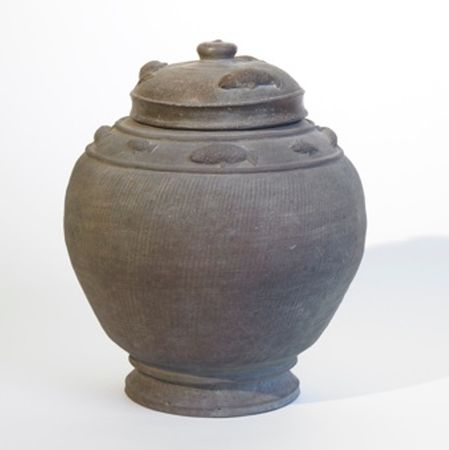
Brown Jar with original lid and incised lines around the globular body. Trân Dynasty. Courtesy Zetterquist Galleries

There are also applied fish in relief around the lid and set within a double raised band around the shoulder.  Height: 28cm.

Provenance: Jochen May Collection, Germany.

Menke26_27

Brown Jar with cover and incised line-pattern. Trân Dynasty. Courtesy Zetterquist Galleries

Height: 23cm.  Good condition.

Provenance: Jochen May Collection, Germany.

Brown Jar with cover and incised line-pattern. Trân Dynasty. Courtesy Zetterquist Galleries

Height: 23cm.  Good condition.

Provenance: Jochen May Collection, Germany.

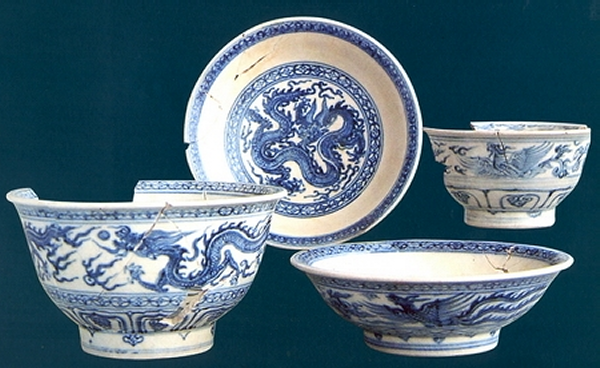
In the fifteenth century, the Chinese stopped exporting their porcelain, and Vietnam became one of the most important exporters of blue and white and enameled porcelains in the world.  There are fifteen examples of fine Vietnamese blue and white porcelains from the fifteenth and sixteenth centuries, including a variety of forms and decoration.  They are delicately and joyfully painted with birds, fish, dragons, landscapes and floral motifs.  The most important piece in the collection is a large barb-rimmed plate depicting four islands in a seascape surrounded by three bands of lotus, wave and cloud decoration.

Menke42

Blue and White plate with two birds flying in around eachother surrounded by various flora. Lê Dynasty. Courtesy Zetterquist Galleries

Diameter 23.5cm.  Good condition.

Menke35

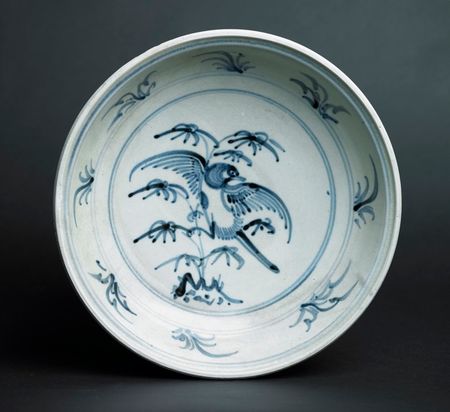
Blue and White Bird Plate with depiction of a single bird and trees. Lê Dynasty. Courtesy Zetterquist Galleries

Diameter: 23.5cm.  Some rim chips.
Menke41

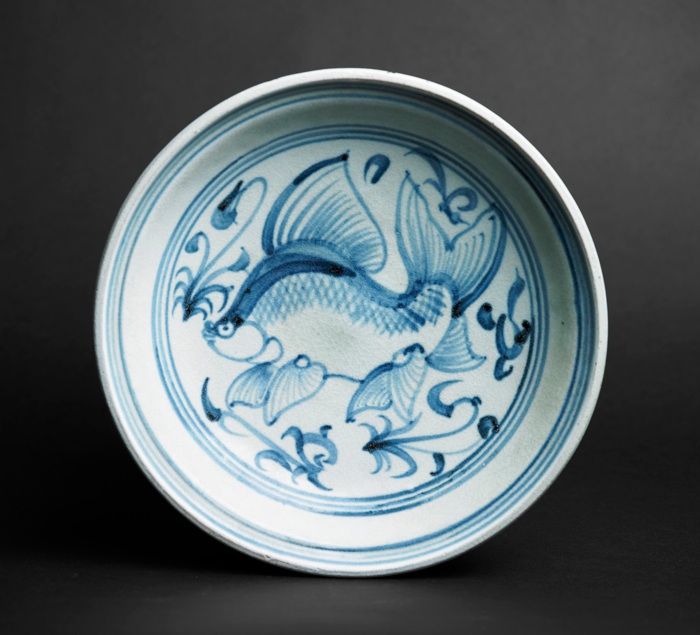
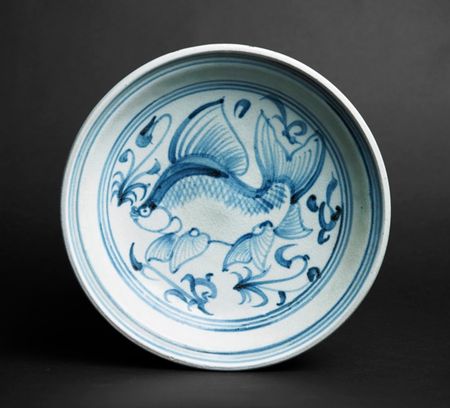
Blue and White Fish Plate with fanciful depiction of flounder like fish with extravagant fins swimming amongst water plants. Lê Dynasty. Courtesy Zetterquist Galleries

Diameter: 22.5cm.  Good condition.

Published in: “Vietnamese Ceramics: A Separate Tradition” by John Stevenson and John Guy, 1997.  Plate 275.

Menke36

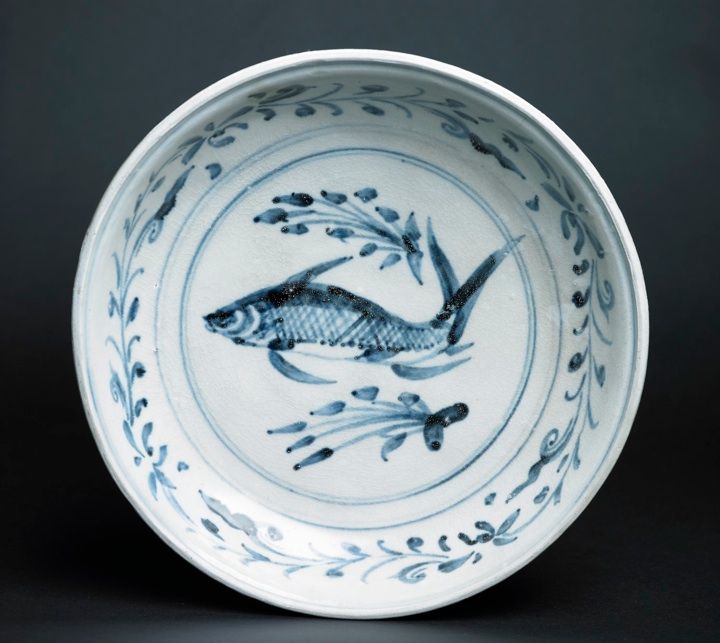
Blue and White Fish Plate with single fish swimming among water plants, set within a band of scrolling lotus.  Lê Dynasty. Courtesy Zetterquist Galleries

Diameter: 23.8cm.  Two hairline cracks.
Menke44

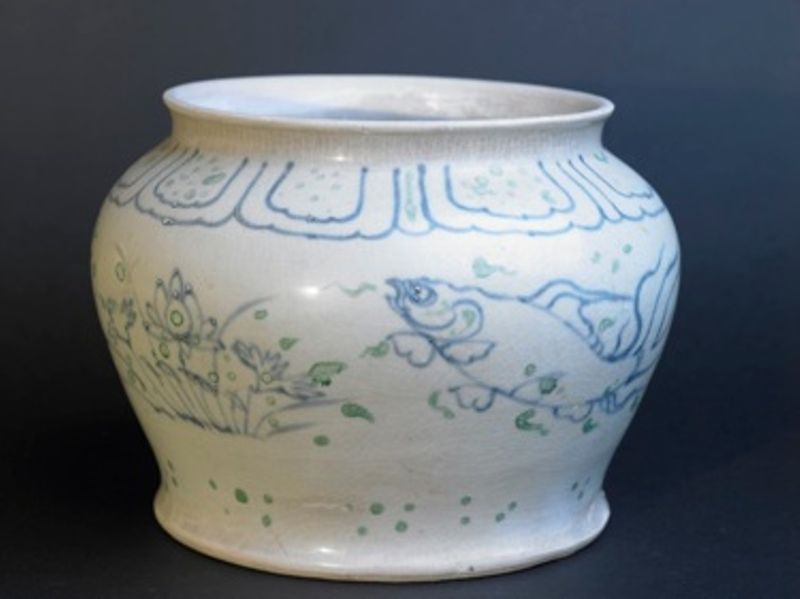
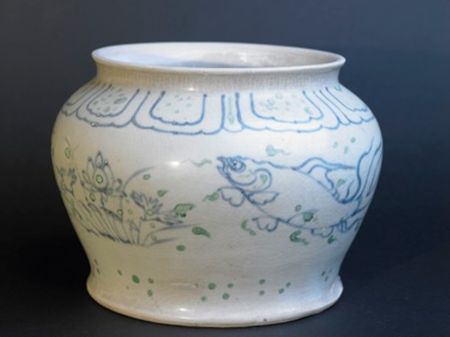
Large blue and white jar with green detailing of fish swimming amongst lotus plants.  Lê Dynasty. Courtesy Zetterquist Galleries

Approximate Height: 22cm.  Minor mouth rim chips.

Published in “Vietnamese Ceramics: A Separate Tradition” by John Stevenson and John Guy, 1997.  Plate 533.
Menke43

Large blue and white jar with green detailing of fish swimming amongst lotus plants.  Lê Dynasty. Courtesy Zetterquist Galleries

Approximate Height: 22cm.  Minor mouth rim chips.

Published in “Vietnamese Ceramics: A Separate Tradition” by John Stevenson and John Guy, 1997.  Plate 533.
Menke46_52

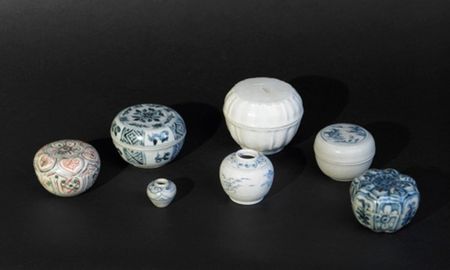
A group of five small covered porcelain boxes ant two miniature jars. Lê Dynasty. Courtesy Zetterquist Galleries

Three of the five boxes and the two jars are decorated with cobalt blue floral and landscape decorations.  The largest of the boxes is pure white and one of the boxes has polychrome accents (red retouched).  Diameters:3cm – 8.5cm   All in good condition

Finally, the seventeenth century is represented by a fine altarpiece with an elaborately modeled beast supporting a candle holder with an attendant rectangular censor.

Menke56

Altar pieces consisting of a large candle holder in the form of a mythical beast sitting on a plinth with a tall squared pedestal resting on its back. Late Lê Dynasty, 17th century. Courtesy Zetterquist Galleries

The top of the pedestal is surmounted by a rectangular  platform with elaborately carved protrusions surrounding a round candle receptacle.  Covered in a straw colored glaze with dark green highlights.  Repair to beasts tail and mane, and also to the extremities at the top.  Crack to base..Altar pieces consisting of a large candle holder in the form of a mythical beast sitting on a plinth with a tall squared pedestal resting on its back.  The top of the pedestal is surmounted by a rectangular  platform with elaborately carved protrusions surrounding a round candle receptacle.  Covered in a straw colored glaze with dark green highlights.  Repair to beasts tail and mane, and also to the extremities at the top.  Crack to base..

The attendant censer is in the style of bronze pieces of the era and sits on a reticulated pedestal base and shares many of the decorative elements of the candle-holder. Heights: 48.2cm and 16.3cm.  Chips and breaks to minor appendages, two back legs broken and missing.
Source: http://elogedelart.canalblog.com/archives/2011/01/11/20096893.html


Vietnam pottery history

Vietnam pottery history. Vietnam ancient pottery – at the Vietnam History Museum and the Vietnam Fine Arts Museum.

 Ceramics is one of the important inventions of our ancestors for thousands of generations, ceramics has been closely linked with the lives of our people. With creativity and deft hands of the potter, pottery Vietnam has become a kind of folk art deep nature.
Traditional pottery
Vietnam traditional ceramic has been around six, seven thousand years. Pottery appeared in the cultural relics of Hoa Binh, Bac Son culture, culture Halong … Then we see the vestiges of the post-Neolithic Phung Nguyen, Dong Dau stage, stage Go Mun. .. traditional pottery our country has achieved high growth and very rich.
In the legend, the appearance of pottery, porcelain as a mystery, sacred “Ceramic powder substance is located deep in the ground, where the devil sacred keepers. Want to exploit to select a good day. Up to the ground, thanks to the brilliant light of the sun which shed plumb new powder turns into ceramic … “
Actually it was just thrilling legends to increase the key part of the engineering ceramic immemorial. In essence ceramic goods born by skillful hands and creative mind of the craftsman. Vietnam History, Volume 1, page 38 reads: “In the period of Phung Nguyen, stoneware processing techniques have reached peak levels. The ax, chisel mallet … different size scales, are made by grinding, sawing drilling, very complete. These bracelets, earrings, beads … stone can be dressed up, comfort, sophisticated trim. These types of ceramics (pots, bowls, cups, pitcher …) with beautiful shape, strong, healthy, much has been made of the hand. Ceramic outer surface covered with decorative patterns with sharp the lines, the elegantly curved, soft, was coordinated, symmetry and harmony. It is an expression of high aesthetic of Vietnam at that time …. “
So industry Phung Nguyen ceramic period (4,000 years from us) in our country has grown. Humans have known that the turntables devised and created things to coating glaze, add the magic beauty of ceramics.
This was a period of Van Lang. Until Aulac, ceramic industry has developed very strong. Occupation baked clay bricks, tiles … also had this date.
I must say ceramics heyday of the period Ly – Tran (Century XI – XIV). That was in the country prosperous, strong economy, strong military and cultural development, peaceful country, every industry is encouraged to thrive.
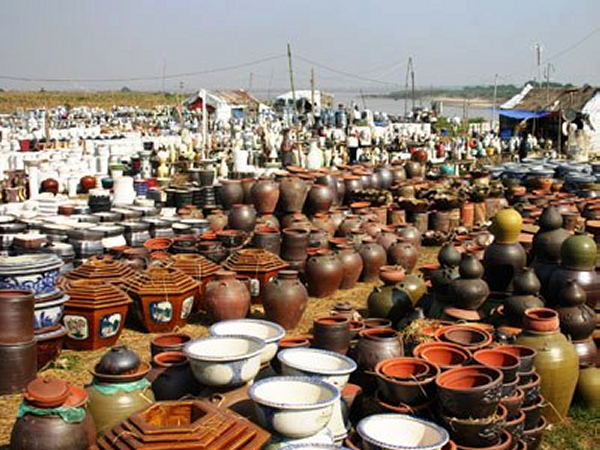
Pottery, watch out development scattered throughout the country. In every province there are areas made pottery. Just along the river, we met several pieces of clay, pottery shards lingering remnant. Or we meet are eating ranges kilns smoke spiraling up. The ceramics center in our country, emerged from the Ly – Tran, but so far still flourishing career, that’s Bat Trang (Hanoi), Tho Ha, Phu Lang (Bac Ninh), Huong Canh (Vinh Phuc ), Que Vol (Ha Nam Ninh), Chum Thanh (Thanh Hoa) … Each country ceramic industry kept separate. And every place, pottery items have their own characteristics, creating the diversity and richness of the Vietnam Ceramic technology. If said ceramic center in our country, to say to Bat Trang – Tho Ha – Huong Canh. A distinctive character and clearest of all pottery is developed along the river bank watching. Because it means the road transport, and along the river bank clay is the precious raw materials to produce ceramic.
According to documents introduced History of Tho Ha pottery Hebei Culture Company, and material Read Bat Trang pottery, typing documentation of the Institute of Fine Arts, in 1964, said: At about the Ly – Tran had Jewish students (especially students, the new Thai officials from the Tran) was sent to the Song Dynasty porcelain (China) is: Hua Vinh Kieu, who Bo Bat village (Thanh Hoa), Dao Tri Tien, Tho Ha village people (Hebei), Luu Phong Tu, from the village of Ke Sat (Hai Duong). All three of him, you go porcelain ceramic learned profession. After returning home, he selected three good day up in the Red River herd handing ceremony to the villagers. Technology can be classified as follows: Mr. Kieu about Bo Bat, Tho Ha Tien about Mr. Tu of Phu Lang, and:
– Bo Bat Village tyranny of white ceramic.
– Tho Ha Village tyranny of red pottery.
– Village Phu Lang pottery tyranny of yellow, dark.
Half a year after the study, successfully made, the three he took his wares by hand control, offering king view. King saw the beautiful animal, immediately reward the envoys the four words “Middle loving Quan” and gave him a list of three “Launch art philosophy”. Legend, on this occasion, the villagers in the three places are busy and active priestly family. After rising for three weeks of alcohol, people dancing ovation to commend the job he took on the multitudes. After three of his death, three people were respected third place him “Sensei”, ie “The College”.
Ceramic Bo Bat Ward had left off after the North. Along the Red River, a river beach with white clay, they stopped up kilns there, brothel called Bach Ward, later changed to the Bat Trang ward. And today, we popularly known as Bat Trang.
Pottery Ly – Tran thriving, many in number and in quality quarter. Trending two main types of ceramics, are: (1) Ceramics architectural decoration, usually clay to wood, or enamel unique value. For example, patterned tiles to decorate with silhouette, different sizes. Or tile top cows fitted phoenix, dragon head. Or ceramic decorations shaped pointy shaped leaves beginning to mount on the roof or house riem … (2) As for ceramic household, then all genres. Do dishes, warm, casual, cups, jars, jars, jar …
Pottery of this period, in addition to meaningful use in the country, also exported to many other countries.
Each recorded history, from the beginning of the Ly had many countries to trade, barter with our country such as Indonesia, Siam (Thailand) … Go to the twelfth century, the foreign yacht dock our country more crowded. 1149, to set up port Ly Trieu Van Don, to boats on the trading countries. So far, both sides of the harbor along Van Don remaining pieces of pottery in the Vietnam era many producers. In it, there are both pieces of celadon pottery Ly. So, there is no trace to affirm our ancient pottery have reached high levels there?
In our country, where the people themselves caused by foreign. For example: For celadon ceramics of the Ly dynasty made our country is called “Pottery Song” or “map Song”.
Currently, at the Vietnam History Museum and the Vietnam Fine Arts Museum also save a lot of pottery, porcelain of the era of our country. It was to prove vestiges industry in our country the earliest development, and from ancient pottery in our country has occupied an important position in the economy and culture of the nation. Through this, the more we loved more skilful hands and creative minds of the wealthy potter Vietnam. To understand more about the pottery, we want to introduce something about the type of ceramic pottery kilns and ancient in our country.
Ancient pottery kiln
In fact, the principle of the ancient and modern kilns are not much different. It still relies on the basic principle, made up of 3 parts: elected oven, furnace body, chimney systems. Only thing, ancient pottery kiln was small and simple.
Due to the division of use of each type of furnace, it has its own name for the kilns: oven and stove the population. Products ovens primarily serve the court and communicate with the world. And the furnace People are ordinary items for daily living humans, such as cups, bowls, kettles, ovens, pots, jars, jars … As usual, the product in the oven is always first higher technical assistance in civil oven.
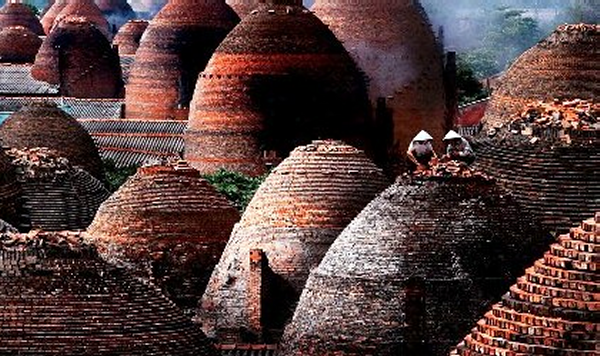
According to Do Van Ninh documents (Institute of Archaeology) on the excavation of pottery kilns in Thap (Thuan Thanh) showed that this ceramic kilns Zone 4 oven with the oven-like structure similar to the same. The entire furnace was apparently shaped melon, between wide aneurysm, truncated both ends. The size measured in an oven with the surface and form larger three other furnaces, shows: length 3.35 meters, width near 2 meters. Thus, the size of a compact furnace that time.
Notably is the kilns, most fuel burning bamboo, wood; Unused fuel coal in this period. Through this, it demonstrates the technical standards of the time and baked for self- conscious raw materials available locally very high.
Others, found that the oven is simple structure and creativity; cover oven ancient craftsmen using clay which only covered but not used to fire brick oven and relatives to vote on the oven. Meanwhile, in China, Tang Dynasty ceramic furnace is not very big (usually 3 meters long, 2 meters wide), so that has to be used to fire bricks to build and build chimney fire door.
According to archaeological documentation of Tran Dinh Luyen 1975 (Bac Ninh Department of Culture) tells us more about the area of ​​ceramic kilns, tile of the land in East Yen, Bac Ninh, located on the waterfront at District Five Odd. Other structure of the oven with the oven type Thap. That circular kilns, 1.2 meters in diameter, wall oven with each piece of crockery embankment small barb, 1 meter thick, Grower wall, above shrink gradually style arches. Funnel gourd shaped oven, wall oven up closely, also by land with approximately 0.2 meters thickness.
Through research, pottery kiln in Dong Yen is somewhat more advanced in Thap. But any progress along the kilns through the ages, we see, until the early twentieth century, the new and improved furnace a big step. It was transformed from frog into boiling furnace furnace module form several large pots. Range modality shift to modular wooden bamboo charcoal and oil heaters. These are far-reaching and confirming the immortal vitality of pottery industry
Today, with modern style pottery kiln, it has been designed for continuous round-style oven. It is a form of advanced brick kilns. It is only once the furnace group, and the fire kept burning oven passed from elected oven to elect the other furnace, the fire was kept burning until the day vulnerabilities. These improvements such intelligence, is the source from the primitive pottery kiln Oldtimer …
Glaze the Ly – Tran
Ly – Tran is the prosperity of the ceramic industry. Therefore, ceramic Ly – Tran rich is inevitable.
Before this period, a number of ceramic pottery in the form of wood, which is not sheathed enamelled coat a layer of ceramic, ceramic coat sewn government did not ple, but Tho Ha and Phu Lang ceramics are used to coat. Ceramic coat is a synthesis between soil solution and vegetarians, with vegetarian recipes 1 4 land. Land is pottery, crushed, screened carefully. There is a kind of stone vegetarian and local rust right. Lent must also crushed, screened carefully. There are two kinds of land and vegetarian then, mixed, mixed with water, dissolved into a solution. All the pottery is baked before being dipped into this solution, creating a ceramic mantle. If so bring baked up, is beautiful and ceramics. Or, in addition, we want enamelled enamelled ceramic class shirt.
Be familiar with the typical three types of ceramic Ly – Tran. That is celadon pottery, ceramics brown, blue and white ceramics.
Celadon pottery: Once you have a good ceramic bones, one thick coating a blue enamel cool, like glass in balls, hence called celadon pottery. Celadon pottery at us very valuable, are popular at home and abroad. People often compare us with celadon ceramics of the Song Dynasty Longquan pottery of China.
Ly Dynasty celadon pottery often bone-thin ceramic bars. Go to the Tran dynasty, the ceramic solid bone, thicker. Decorations on ceramics, mostly stylized lotus image. There’s also a number of other topics, such as seminars and decorative flower pots wires running around. There are three forms of decoration on pottery: carved flowers, flower prints and floral cover. Imprinted or embossed flowers, use the mold, while others rely on knife flower tip or a bone head painted ceramic bamboo stick when ground was soft. Embedded carving flowers and bring yeast, yeast stagnate and create photo beautiful decorations. Besides the celadon pottery and exquisite that picky, craftsmen also produce a mass of pottery, sometimes for carpentry, sometimes thin enamel coating yellow, brown, or skin color that eel dull and less glossy. This type of pottery for common use and when baked, it was baked in piles high.
Ly dynasty, pottery hardly write letters. Go to the Tran dynasty, often seen as ham kinds of ceramics with brown inscription “Thien Truong government institutions.”
Brown ceramic flower: It’s kind of ceramic board, to design, certainly, remains thick and coarse pottery. Outside enamel coated ivory or light yellow. Ceramic brown flowers appear at the end of the first Ly Tran.
Decorative form of flower pattern on brown ceramic flower wire usually runs around the mouth rim pottery. In particular, most of the ceramic ribs with brown flowers embossed floral workshop, storks, four-legged animal, fish or shrimp … very lively. The dragon-shaped flowers decorated in brown pottery Ly Tran dynasty with another. It is healthy fat dragon himself, meandering comfortable, unlike the Ly dragon slender body and meandering cramped.
Blue and white ceramics: the name of a white enamelled ceramic septic painted blue decoration.


For a beautiful glaze colors, it is necessary to have good core ceramic bone. Watch out, usually ceramic bone is sandy clay. If pottery, to challenge a number of other impurities such as straw, rice husks or leaves weeds to increase links.
Reference source:
Vietnam’s Vu Joint land occupations From Home
Source: http://museu2009.blogspot.com/2016/05/vietnam-pottery-history-vietnam.html

Vietnamese Ceramics and Pottery

Vietnamese Ceramics and Pottery

Vietnam is famous for its splendid blue de Hué porcelain. The most beautiful pieces often have a pearl with a flaming tail persued by a dragon, the symbol of the emperor. Like China, Vietnam has a long history of producing great ceramics. Susan Brownmiller wrote in the New York Times, Bat Trang is “an entire village of narrow mud lanes, artisan workshops, treadle heels, and small cross-draft kilns. Moistened pats of charcoal, straw and manure, used for fuel, were drying in rows on brick walls. Women stoically mixed and stirred vast of wet clay with their feet.”

Bat Trang Ceramic Village (Hanoi) is very old. According to historical documents, products from this village were well known as far back as the 15th century. There are many villages throughout the country that produce ceramics. Some of these villages include Phu Lang in Bac Ninh Province, Huong Canh in Vinh Phuc Province, Lo Chum in Thanh Hoa Province, Thanh Ha in Hoi An (Quang Nam Province), and Bien Hoa in Dong Nai Province.

Vietnamese ceramic is now well known in both the domestic and international markets. Traditional products include kitchen items and trays. The flower-patterned bowls of Bat Trang have been exported to Sweden, the cucumber pots to Russia, and the teapots to France. and porcelain items have been produced in Vietnam for a long time. Ceramic and porcelain products glazed by traditional methods into beautiful art are well known in Bat Trang, Dong Trieu, Thanh Ha and Haiphong. [Source: Vietnamtourism. com, Vietnam National Administration of Tourism ~]
Bui Hoai Mai is writing a book about Vietnamese ceramics. For more information contact him at: Jimmai@netnam.org.vn

Ancient Vietnamese Ceramics and Pottery

In prehistoric times, most of the designs on the surface of the ceramics were created with sticks while the products were still wet. All of the pottery products from this era had useful applications for household duties and cooking. Most of the pottery products from the Bronze Age were formed on turn tables and had diverse styles. As well as cooking utensils, there were also artistic ceramics and products for tool production. The diverse products were decorated with carved images and covered by a different colored layer of an enamel-like substance. The adornment of pottery products from this period was performed using bronze tools. [Source: Vietnamtourism. com, Vietnam National Administration of Tourism ~]

Iron Age pottery products developed in all regions of the country. These products were produced at low temperatures using somewhat rudimentary techniques. The form and ornamentation of the Iron Age pottery products was quite unique to this period. This craft developed from traditional experience, and from the influence of the Chinese. Architectural pottery, including bricks and tiles, also originated during this time and small simple statues of animals, such as pigs and oxen, were introduced. ~

In his piece “A Historical Overview of Vietnamese Ceramics,” Phan Cam Thuong wrote: “Ceramic making first appeared in Viet Nam during the country’s primitive stages of development when people gave up their wild existence to live in settled communities, and began inventing new tools and household goods. Artifacts found in archaeological sites dating back as far as the middle of the Stone Age, approximately ten thousand years ago, have been discovered at Bac Son. In the Neolithic Era, when the techniques for making stone objects had reached a high level of sophistication, ceramic products of period also began to take on an artistic character. They were no longer rudimentary jars for containing water or pots for cooking. Hoa Loc ceramic products in particular are endowed with rhythmic designs showing original geometric thinking. [Source: “A Historical Overview of Vietnamese Ceramics” by Phan Cam Thuong, Vietnam Art Books.com, VietNam Cultural Windows. Phan Cam Thuong is a researcher, art critic and writer of over 12 books in the art and art history fields. He is now a professor at the Hanoi Fine Art University and an acclaimed artist. \+\]

“The invention of pottery probably started from observation of the effect of fire on the surface of the earth. Primitive people must have noticed that on places over which fires had passed, the earth became very hard. They began to dig holes, which were baked and turned into containers for harvested rice or water. All the shapes of ceramic products likewise came into existence in the same natural way. Ancient rice bowl and dishes for instance are shaped like cupped hands the form we make with our hands to hold spring water. Jars and bottles used as containers have the same shape as fruits. \+\

“Knitted and woven products such as baskets and bamboo cages also influenced the shape of early ceramic products. Ancient jars were made by plastering knitted objects with clay before putting them into a kiln. At high temperatures, the knitted cage would burn, leaving on the ceramic jars its traces, which became small decorative motifs. Many ancient ceramic products of the Stone Age in Viet Nam bear such traces of decorative motifs. This is one possible explanation as to how the decoration on the outer surface of pottery was invented. Ceramic objects decorated with rhythmic design came into existence after the emergence of the potter’s wheel. \+\

Today we can accurately reconstruct the process of shaping and decoration employed in each of the three stage of ceramic art of the Bronze Age: Phung Nguyen (4,000 years ago), Dong Dau (3,300 years ago) and Go Mun (3,000 years ago). The processes involved in making ceramic of this period are similar to those still used in the Vietnamese countryside today. The techniques used to decorate ceramic objects of the three above-mentioned stages became the early models for decorative motifs used on the bronze objects of the Dong Son period. Sa Huynh and Dong Son ceramic in period of the Iron Age reached a remarkably high level of technical sophistication, even as precious bronze objects were beginning to come into common use. We must also add that the tools used during this period were primarily made of iron whereas the household goods were often ceramic and instruments made of bronze. Sa Huynh ceramic objects, characterized by their thickness, were generally made in the South of serve as tombs or as containers for possessions of the dead. The interaction between the shaping of bronze objects and that of ceramic is obvious; many of the ancient ceramics have the same shape as the bronze objects and vice versa. \+\

Vietnamese Ceramics and Pottery from the Period of Chinese Domination

In his piece “A Historical Overview of Vietnamese Ceramics,” Phan Cam Thuong wrote: “During the ten centuries of Chinese domination and continual struggles for independence, the Vietnamese went on producing ceramics according to their traditional methods, while trying to learn and adapt techniques of the Chinese version of the craft. [Source: “A Historical Overview of Vietnamese Ceramics” by Phan Cam Thuong, Vietnam Art Books.com, VietNam Cultural Windows. \+\]

“Ceramics excavated from Chinese tombs give evidence of the above statement. These include objects brought by Han from China, those produced by the Vietnamese, and those made by the latter according the specifications their Chinese patrons. Ceramics found in Chinese tombs from the areas stretching from Quang Ninh, Hai Duong to Bac Ninh have common shapes of the time: vessel-shaped bowls, tall cups with large mouths, tall vases called dam xoe with slender necks, large mid-sections and bell-shaped bases and terracotta house models in the architectural design of the tu dai dong duong (dwelling of four generations living together). \+\

“It is obvious that bronze objects aesthetically influenced most of these ceramics; the geometric decoration and relief motifs of the ceramic products of the period closely resemble those of bronze objects. Thanks to the high level of technical sophistication and the use of the potter’s wheel, the products were thick-walled (0.5 cm), having solid bodies with a high proportion of silicate and covered with a thin yellow or white glaze. \+\

Ceramic artifacts of the 8th, 9th and 10th centuries have also been excavated; many of these were made in the style of Tam Thai (three colors) ceramics, which flourished under the Tang Dynasty. They are covered with a transparent green glaze which accumulates in places into small lumps forming different patterns, a technique known as the “dripping spectrum” an inelegant name connected with a product considered so precious. \+\

Vietnamese Ceramics and Pottery in the Early Imperial Era

After more than ten centuries of Chinese domination, the Ly and Tran dynasties saw the reestablishment of national independence. During this period, pottery experienced splendid achievements in quality and diversity through large-scale production. Basic elements, including the form, decorations, and colored enamel, were employed t o create beautiful products. The painted decorations were simple, but incredibly attractive. Unique carving characteristics developed and various kinds of enamel were applied. [Source: Vietnamtourism. com, Vietnam National Administration of Tourism]

In “A Historical Overview of Vietnamese Ceramics,” Phan Cam Thuong wrote: “Vietnamese ceramics underwent an extraordinarily creative period during the Ly Dynasty (1010-1225). Craftsmen of this period undoubtedly drew inspiration from the ancient tradition of Vietnamese ceramics as well as from that of the Tang Dynasty’s Tam Thai ceramics and the Celadon porcelain tradition of the Song from China. The jade glazed ceramics of the Ly Dynasty were famous all over the Southeast and East Asian region and were prized for their beauty as far away as the Middle East. Many of the ceramics products of this period were slender in shape and covered with an emerald glaze. The glaze was produced in different shades: pale grayish green, yellow green. Light green, violet green, etc. Decorative motifs covered by the glaze remained distinct and could still be clearly seen. There were also while and black, and iron-brown glazed ceramics, all very pleasing to the eye. All of the ceramics were imbued with the same aesthetic, which underlined other artistic areas such as architecture and sculpture under the Ly Dynasty. [Source: “A Historical Overview of Vietnamese Ceramics” by Phan Cam Thuong, Vietnam Art Books.com, VietNam Cultural Windows \+\]

“Alongside the traditional ceramic centers of the Ly period in Thanh Hoa and those of the Tran Dynasty (1226-1400) in the Thang Long (now Hanoi), others were later developed in Quang Yen and Nam Dinh. According to historical documents, mandarins of this period such as Hua Vinh Kieu, Dao Tien Tri and Luu Phong Tu, who served as ambassadors to China, studied Chinese techniques of pottery making, bringing them back to Viet Nam. They taught the art to villagers in Bat Trang (Hanoi), Tho Ha (Bac Giang) and Phu Lang (Bac Ninh province). Bat Trang Village specialized in gom sac trang (white ceramics), Tho Ha in gom sac do (red ceramics) and Phu Lang gom sac vang (yellow ceramics). The white ceramics with blue motifs produced at the time differ very little from one made in Bat Trang Village today. The red pottery of Tho Ha, which was terracotta, consisted mainly of large jars and glazed coffins used in the traditional re-burying of bones of a dead body three years after the initial burial (alt for bones). While the yellow or greenish-yellow “eel skin” pottery is still produced in great quantity in Phu Lang, Tho Ha Village ceased producing it a century ago. \+\

“Terracotta products came into existence earlier than other kinds of ceramics and have continually developed throughout Viet Nam’s history, though only those of the period between the Dinh (967-980), Ly (1009-1225) and Tran (1225-1400) Dynasties reached heights of artistic excellence. Bricks were produced for paving house foundations, constructing walls and miniature towers, tiles for covering roofs, phoenix or dragon-shaped architectural decoration, and incense burners. Binh Son Tower (Vinh Phuc), 14 m high, dating back to the Tran Dynasty, is a perfect terracotta construction down to the smallest details; nothing like it has been built since. \+\

“Just as glazed ceramics were representative of the Ly period, so iron-brown pottery was of the Tran. There are two kind of latter: white background with brown motifs and brown background with white. Ceramics during the Tran period were large and simple in shape: artifacts from this period have a strong and majestic appearance, which conveys the militant spirit of the Tran Dynasty. At the end of the Tran period there also appeared gom hoa lam (white- blue glazed ceramics) and other, which used glazed of various colors between the established jade green and the blue-white glazes or between the brown and the blue-white glazes. Not until the Posterior Le (1427-1527) did white-blue glazed ceramics reach their full development. \+\

Vietnamese Ceramics and Pottery in the Late Imperial Era

Since the 15th century, ceramic started to bear white enamel with blue designs and fabrication techniques improved. Nowadays, some localities are still specialized in producing ceramics, including Bac Ninh Province, Thanh Hoa Province, Nam Dinh Province, and Hanoi.

Phan Cam Thuong wrote: “”Based on the traditional techniques of making white-blue and iron-brown glazed ceramics, Dang Huyen Thong, a pottery collector and famous craftsman of the Mac period (1527-1598), created a new kind of ceramics decorated with geometric designs and motifs in relief. The power and solemnity evoked by the designs of Dang Huyen Thong’s new pottery expressed the turmoil of the 17th and 18th centuries: ceramic art together with other handicraft developed alongside the changing village and urban centers in the context of a country divided by an internal war which lasted for two hundred years. [Source: “A Historical Overview of Vietnamese Ceramics” by Phan Cam Thuong, Vietnam Art Books.com, VietNam Cultural Windows \+\]

“After transferring its capital to Hue, the Nguyen Dynasty (1802-1945) also paid attention to the ceramic craft for the service of the court and daily life. New centers of porcelain and ceramic production such as Mong Cai and Dong Nai began to emerge alongside long-established old centers and kilns. The porcelain trade under Qing Dynasty in China and the Nguyen in Viet Nam prospered. Many courtiers of Asia Minor and Central Asian imported Vietnamese ceramics. \+\

“Nowadays modern ceramics are based on traditional techniques of ceramics making which have operated for hundreds of years. What on the past was a glorious craft requiring great skill is today another developing branch of industry. Beside the ancient centers, which are still operating and continue using traditional methods, many new and old communities have begun using imported techniques, such as casting, the use of chemical glazes, and firing in gas or electric kilns. The shapes and decorations of many products now follow international aesthetic tastes. Traditional ceramics, however, retain their own value, an ancient tree amidst an industrial forest. \+\

Bat Trang Markets Its1,000-Year-Old Ceramic

Associated Press reported from Bat Trang: “Nguyen Trong Hung smoothes his weathered hands over a 1.5-metre-tall porcelain vase spinning hypnotically on a potter’s wheel. Years of practice make his movements look effortless as he creates a flawless work based on traditions passed down through generations. Bat Trang, a village on the Red River just outside Hanoi, has been producing ceramics and pottery for 1,000 years and is known throughout Vietnam for its quality and innovative wares. [Source: Associated Press, December 5, 2004 <>]

“And, with communist Vietnam opening its doors to a market economy, artisans like Hung, who were once forced by the government to work for pennies, are now fledgling entrepreneurs dreaming that their village will someday rival France’s famed Limoges porcelain region. “All of the ceramic craftsmen in this village are very proud of the craft we inherited 1,000 years ago from our ancestors,” says Hung, who began learning the trade at age five. “We hope with this project, more people in the world would know about Bat Trang ceramics and that would help to raise the sale of our products to a new height.” <>

“Hung’s family and 26 others from the village of 400 ceramics producers have joined a pilot project – the Bat Trang Porcelain and Ceramics Association – that began promoting their wares in November. They hope that with some expertise from the Mekong Private Sector Development Facility – which is managed by a branch of the World Bank and which has pledged $150,000 over two years for a Web site, a trading center and improved marketing – they can begin selling directly to department stores abroad. <>

In 2003 “the village, which employs an estimated 30,000 people, exported about $23 million US worth of ceramics. It’s a number that project head Len Cordiner hopes to double over the next three years. “I think it’s ambitious, but it’s very doable,” Cordiner says. “To become a household name will take 10 or 20 years, but we may – at least I’m hoping – do reasonably well in the wholesale and retail trade.” There are hundreds of craft villages scattered across Vietnam with skilled artisans making everything from rattan and wrought iron furniture to silks and lacquerware. But Bat Trang is special. <>

“Its history traces back to a site outside the ancient capital of Hoa Lu in northern Vietnam where pottery artisans once gathered. In 1010, the craftsmen moved with the capital to Hanoi, and relics of Bat Trang pottery and ceramics have been unearthed at the site of an ancient citadel there – evidence that even Vietnam’s royal families used wares created by the villagers’ ancestors. Bat Trang products have been found in shipwrecks across Southeast Asia and exhibited in museums worldwide. Foreign experts were surprised to find that some of Bat Trang’s ancient techniques were more modern and sophisticated than expected, similar to relics found in Japan and China, says Duong Trung Quoc, a Vietnamese historian. “The cultural value of the product is its economic strength,” he says. “It helps the foreigners understand Vietnam, and the quality of the product will help them to believe in other products made by Vietnam.” <>

“While still making each item by hand – right down to the intricate scenes and patterns etched on the porcelain – some families are innovating. Three years ago, Hung switched from a coal-fired kiln to one powered by natural gas. It’s 50 percent more expensive, but his pieces are more evenly heated and there is no more messy coal dust or time lost hauling in fuel. Only 30 percent of his output is exported now, but Hung’s family earns about $6,370 annually, far above the national average of about $420 a year and a big change from the poverty and hardship of two decades ago. After the Vietnam War ended in 1975, the communists forced Bat Trang’s villagers to produce bowls and plates that Hung says paid only pennies for a day’s work, enough to buy just over three pounds of rice. It was when Vietnam started opening up the economy and promoting private businesses that the village began making money. Today ceramic-filled shops line both sides of the street leading into the village and a large outdoor market booms near the river. <>

“Cordiner hopes to eventually begin tours to Bat Trang and to create a similar niche like Les Artisans d’Angkor has done in Siem Reap, Cambodia, where craftsmen make lucrative, high-quality souvenirs. “We’re leveraging the history of the town and the history of ceramic production, which are closely tied,” he says. “It’s visible, tangible evidence of history.” <>

15th Century Vietnamese Dish

Describing a 15th–16th century stoneware dish with underglaze cobalt blue decoration, Steven M. Kossak and Edith W. Watts of the Metropolitan Museum of Art wrote: “Though real elephants are large and heavy, the one pictured at the center of this plate seems to float among Chinese-style “wish-granting” clouds. From very early times, the Vietnamese had been influenced by the beliefs and art styles of their large neighbor, China. By the fifteenth century, Chinese blue-and-white ware was famous worldwide and Vietnamese potters had also begun to excel in this borrowed technique in which the designs are painted in cobalt blue on the white porcelain surface. The surface is then coated with a transparent glaze before firing. [Source: Steven M. Kossak and Edith W. Watts, The Art of South, and Southeast Asia, The Metropolitan Museum of Art, New York ><]

Although the clouds and the blue-and-white underglaze technique are derived from China, the way the elephant is portrayed is entirely different. In India, the elephant was an ancient symbol of royalty. In China, ele- phants were imported to add to the grandeur of imperial ceremonies and processions. In Vietnam, elephants were domesticated and were essential vehicles for transporting people and goods. Perhaps that is why the deco- rator of this dish painted the elephant with such familiarity, humor, and affection. The elephant turns as if to admire its loose hide, which is patterned with dot clusters resembling flowers. The curves of its soft chin and large eyes (with eyelashes) create a smiling expression. The rounded outlines of the cloud patterns and the elephant’s tusk, trunk, and body fit harmoniously inside the central circle of the dish. ><

Image Sources:

Text Sources: New York Times, Washington Post, Los Angeles Times, Times of London, Lonely Planet Guides, Library of Congress, Vietnamtourism. com, Vietnam National Administration of Tourism, CIA World Factbook, Compton’s Encyclopedia, The Guardian, National Geographic, Smithsonian magazine, The New Yorker, Time, Newsweek, Reuters, AP, AFP, Wall Street Journal, The Atlantic Monthly, The Economist, Global Viewpoint (Christian Science Monitor), Foreign Policy, Wikipedia, BBC, CNN, Fox News and various websites, books and other publications identified in the text.

© 2008 Jeffrey Hays

Last updated May 2014

Source: http://factsanddetails.com/southeast-asia/Vietnam/sub5_9e/entry-3428.html#chapter-11

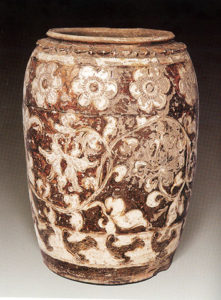
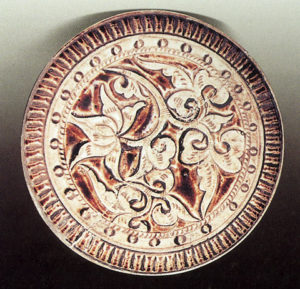
Brown pattern and brown ceramics of Ly – Tran dynasties, 11th – 14th century

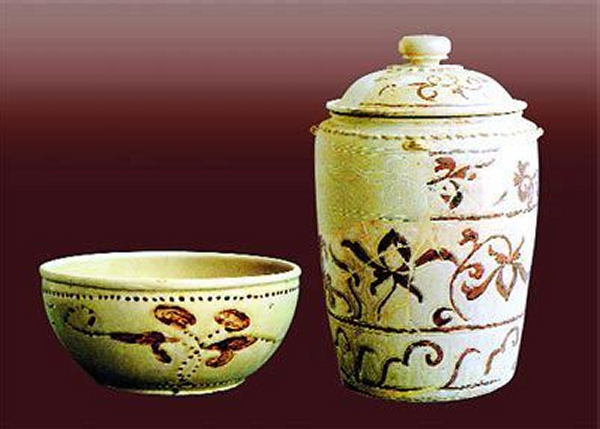
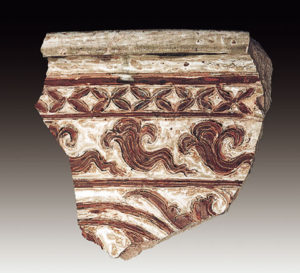
The brown pattern ceramics of Ly-Tran dynasties were made carefully with thick bone and brown glazed patterns against ivory glazed ground or with brown glaze only. This included types of domestic wares and ceremonial purposes, such as: ewer, tureen, jar, bowl, vase, lamp-stand, basin, cup, plate, box, stupa, urn, stem-cup, statue…

They also include some kinds of large jars. Their typical style was brown inlaid patterns in reserve against an ivory glazed ground. Besides, some had under-glazed brown patterns and ivory glaze which resembling the cobalt blue pattern ceramics. On the other hand, the embossment decoration was also applied.

Their decorative patterns reflect Buddhism and Taoism influence and otherwise human and nature. It also related to the pattern designs of other contemporary ceramics, such as white glazed ceramics, celadon glazed ceramic as well as other materials including stone, terra-cotta, wood, bronze, gold…

Decorative motif:

– Buddhism such as Buddha figure sitting on the lotus petal pedestal, Kinnara and Kinnari, the male and female half-bird and half-human singers for Indra, the Indian Rain God…

– Dragon was not popular but already on the lid of the box or stupa and this is an important mark for defining the date of the object.

– Motif of human activities was exploited and this is one of the most attractive subjects for the antiquity collectors. The spearmen figure exercising of fighting or hunting with sword and shield on their hand reflected the atmosphere of the country in the resistance against Mongol Empire.

– Animal motif as elephant, tiger, horse, deer and birds as cock, peacock, parrot… or aquatic creatures as fish or prawn.

– Vegetation motif as lotus flower, lotus petal band that were carved on the shoulder of the ewer, situla, tureen, plate, vase base, box … In particular, the lotus petal band that was made in different styles was a feature for determining the date of the object. For example, if the lotus petal band is embossed, and the lotus petal is big or small size, long or fat, equal and elaborate, the object can be dated to Ly dynasty. Otherwise, if the lotus petal is flat, and the petal’s top-end is round, the object can be Tran style. The lotus flower patterns could be inlaid or brown glazed were very common on products such as ewer, jar, lamp-stand, urn, tureen… The lotus flower was normally described in various forms: tiered lotus petal pedestal, carved or molded lotus petal collar on the shoulder of jars, inlaid lotus scrolls, inlaid lotus flower and leaves repeated in panels, potted spray and stylized lotus.

The brown ceramics were crafted in the following ways:

– Ivory inlaid patterns in reserve against a brown glazed ground

– Brown inlaid patterns in reserve against an ivory glazed ground

– Unglazed patterns carved through brown glaze

– Under-glaze brown patterns and ivory glaze

Regarding the date of the ceramic:

Based on the data of the inscription, motif of the objects that found through excavations or accidentally, the date of the ceramics could be determined to date: Ly dynasty (11th -13th century), Tran dynasty (13th – 14th century) and Tran-Early Le (14th – 15th century).

Here are some examples of the ceramic:

Ewer of the Ly dynasty can be in shape of a peach, decorated with Kinnari with two hands holding the ewer’s spout, brown glazed on its head, wing, leg and tail, ivory glazed ground. One ewer has a body lobed into lotus petals covered with brown glaze, lotus petal collar on shoulder, bands of brown glaze on neck and shoulder. All decorated being glazed brown under an ivory glaze ground. (see picture)

Ewer in Tran dynasty includes a piece of ewer in elephant shape with driver, ivory glaze ground with brown glazed decorative detail. Or ewer in bulbous body, bending spout, spiral handle, chicken-foot decoration.

In 14th-15th century, brown ewer has a melon shape, dragon-head spout, body carving a round band of flower scroll and elipses between 2 brown paralel lines.

Vase in Ly dynasty has flaring mouth, short neck, globular body, band of tiny circle in brown glazed on the neck and foot. Or in yuhuchun shape, body molded into petal-slices incised with foliage.

Vase at the end of Tran and early Le dynasty has cylindrical shape, heavy rim, flat base, embossed dragon- shape shoulder and two horizontal ears, decorated with three bands of flower and wave in brown glazed on ivory glaze ground.

Basin remnants were found in Thang Long citadel relic. A broken sample of the basin has a thick rim, carving lotus petals, brown and ivory white glaze. Another sample was decorated with lemon flower, cloud pattern and flower scroll.

In the Tran dynasty ceramic site in Da Ton commune (Gia Lam, Hanoi), basins of brown ceramic have been found. They are basins with rim, curved edge, large base, with inlaid brown lotus flower pattern decoration repeated in four panels on exterior, similar to those found in Tam Duong site, Thai Binh province.

Also in Da Ton site, in 1978, an accidental excavation had found two brown basins together with 3 cobalt blue pattern plates. Those two basins have been preserved in Ha Noi Museum. One is decorated with apricot flower band and inlaid brown classic scrolling on ivory white ground. The other was brown glazed on whole exterior, apricot band carving, and inlaid unglazed flower in the lower part. Those artifacts resembled to brown ceramic products in Bat Trang village which located next by Da Ton village, and dated back to 14th-15th century (end of Tran, early Le).

Plates in shape of lotus petals were found in Thang Long sites. They are ones with flat and unglazed bottom and inlaid lotus flower patterns, exterior decorated with 2 or 3 layers of lotus petals, dancing lady decoration on the base. On the rim or around the base can decorate brown glazed tiny rings band.

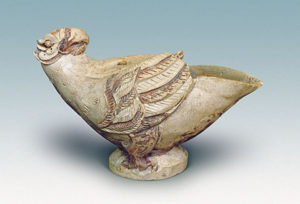
Statues: Ly dynasty’s statues found in Thang Long site, there was a ewer in parrot shape, standing on flattened round unglazed base, head, wings and legs in brown glazed, ivory glazed ground. A statue of cat in 7,5cm height, in a shape of a cat sitting, brown and ivory glazed.

Tran dynasty’s statues include a ewer in elephant shape with driver, ivory glazed ground with brown glazed decorative detail. Or human heads with hair bound in a turban, 4-5cm height, brown glazed. Or statue of an elephant driver, brown glaze, 10cm height with trunk bent up to the forehead.


* The brown glazed ceramics in Ly and Tran dynasty represent a fascinating development in the history of Vietnamese ceramics. The ceramics of this period had reached to a top level in the style design and decoration. The designs were so sophisticated to turn the objects to be real artworks. The bone were high quality resulted from good filtering and firing. The glaze was shiny and deep making the products beautifully. The motifs exploited were so various, from fauna and floral subjects to Buddhism symbols, especially the lotus.

Brown pattern and brown ceramics of Ly and Tran dynasty are not only high quality but also represent for a spirit of reviving Vietnamese traditional cultural values. For example, the common motif of Dong Son culture as “S” character, dotted line, ladder motif and anticlockwise flying birds…

Dr. Nguyen Dinh Chien (Former Deputy Director of VNMH)

EN: Tran Trang

Source: baotanglichsu.vn

Bắc Sơn – nền văn hóa tiêu biểu nối tiếp văn hóa Hòa Bình

1. Niên đại và địa bàn phân bố văn hóa Bắc Sơn

Từ khoảng trên dưới 1 vạn năm về trước, chủ nhân các bộ lạc Bắc Sơn đã nối tiếp quá trình phát triển của cư dân văn hóa Hòa Bình. Nhiều hiện vật của văn hóa Bắc Sơn được phát hiện tạo thành lớp trên của văn hóa Hòa Bình trong cùng một di tích cho thấy điều đó.

Tuy ra đời muộn nhưng văn hóa Bắc Sơn có quan hệ gần gũi với văn hóa Hòa Bình và cùng kết thúc thời gian cách ngày nay khoảng 7000 năm.

Cư dân Bắc Sơn sống rải rác trong các hang động, mái đá vùng núi đá vôi gần sông, suối. Thuộc vùng trung, thượng du các tỉnh Hòa Bình, Ninh Bình, Thanh Hóa, Nghệ An, Quảng Bình,… Nhưng chủ yếu ở Lạng Sơn, Thái Nguyên. Tính đến năm 1997, các nhà khảo cổ học đã phát hiện được 50 di chỉ khác nhau thuộc văn hóa Bắc Sơn. Căn cứ vào sự phân bố các di tích, có thể khẳng định, địa bàn cư trú của các bộ lạc người Bắc Sơn đã được mở rộng hơn.

2. Kỹ thuật chế tác công cụ trong văn hóa Bắc Sơn

Cũng giống như người Hòa Bình, cư dân Bắc Sơn sử dụng cuội để chế tác công cụ, song kỹ thuật chế tác đã đạt đến trình độ cao hơn. Họ không chỉ biết ghè, đẽo công cụ mà còn biết mài đá. Trong nhiều hang động thuộc văn hóa Bắc Sơn, các nhà nghiên cứu đã tìm thấy nhiều chiếc rìu bằng đá cuội được mài ở lưỡi, bên cạnh những công cụ được ghè đẽo một mặt kiểu Hòa Bình. Rìu mài lưỡi khá phổ biến trong các di tích văn hóa Bắc Sơn và là công cụ đặc trưng cho nền văn hóa này, các nhà khảo cổ học thường gọi là rìu Bắc Sơn (hay rìu mài lưỡi Bắc Sơn).

Trong kỹ thuật mài, người Bắc Sơn thường chọn những hòn cuội dẹt, dài, đẽo qua loa trên hai cạnh và lưỡi rồi đem mài trên một bàn sa thạch, tạo nên mặt lưỡi phẳng và sắc. Những bàn mài của người Bắc Sơn thường có hình lòng chảo lõm. Cũng có những bàn mài được làm từ phiến đá có những rãnh song song, giữa hai rãnh là phần cong nổi lên. Những chiếc bàn đá mài như vậy đã giúp chủ nhân của văn hóa Bắc Sơn tạo ra được chiếc rìu đá khá sắc bén, với nhiều kiểu dáng khác nhau (như: rìu có vai, rìu có chuôi tra cán, rìu tứ diện được mài cả hai mặt…). Ở di chỉ Đa Bút (Thanh Hóa) người ta đã phát hiện được một số rìu được mài nhẵn toàn bộ hai mặt lưỡi. Rìu mài lưỡi ở Bắc Sơn ra đời cách ngày nay trên dưới 1 vạn năm, có thể xếp vào loại rìu đá mài sớm nhất thế giới. Cũng nhờ có kỹ thuật mài, những chiếc rìu Bắc Sơn sắc hơn rìu Hòa Bình, do đó, năng suất lao động được nâng cao hơn trước[1].

Chủ nhân của văn hóa Bắc Sơn không chỉ có kỹ thuật đá mài trong chế tạo công cụ mà họ còn biết đến kỹ thuật làm đồ gốm. Đặc điểm của đồ gốm Bắc Sơn là có những đồ đựng, đồ nấu có cả miệng loe, đáy tròn. Con người thời bấy giờ đã lấy đất sét nhào với cát để khi nung đồ gốm không bị rạn nứt. Nhìn chung, độ nung gốm thời kỳ này chưa cao, hình dáng đồ gốm còn thô, số lượng đồ gốm còn ít. Có thể nói rằng đồ gốm trong văn hóa Bắc Sơn chưa nhiều, kĩ thuật gốm chưa phát triển. Tuy nhiên, việc xuất hiện đồ gốm trong văn hóa Bắc Sơn đã đánh dấu bước tiến mới về loại hình công cụ trong buổi đầu của thời đại đá mới. Vì vậy, các nhà khảo cổ học thường gọi văn hóa Bắc Sơn là văn hóa đá mới có gốm sơ kì. Việc tạo ra kỹ thuật làm gốm là một trong những dấu hiệu cho thấy văn hóa Bắc Sơn có sự phát triển cao hơn văn hóa Hòa Bình.

3. Trạng thái kinh tế, đời sống xã hội và đời sống tinh thần trong văn hóa Bắc Sơn:

Về đời sống kinh tế

Kỹ thuật chế tác công cụ của cư dân Bắc Sơn có nhiều tiến bộ so với trước (đặc biệt là kỹ thuật mài). Điều đó đã tạo điều kiện thuận lợi cho cư dân Bắc Sơn chế tạo ra được nhiều loại hình công cụ khác nhau từ đá, tre, gỗ, xương, sừng,… Đó là điều kiện tiên quyết để nâng cao hơn nữa năng suất lao động thời kì này lên một bước.

Ở các di chỉ thuộc văn hóa Bắc Sơn đã tìm thấy nhiều chày đá và bàn nghiền hạt; một số bàn nghiền hạt có dấu hiệu bị lõm ở mặt, có thể đây là những bàn nghiền hạt các loại cây trồng của cư dân thời bấy giờ [2].

Tuy nhiên, kinh tế nông nghiệp vẫn chưa giữ vai trò chủ đạo trong đời sống kinh tế – xã hội của con người Bắc Sơn. Hái lượm, săn bắn vẫn là những hoạt động kinh tế chủ yếu của con người thời kì này. Việc tìm thấy trong các hang động cư trú của người Bắc Sơn (như hang Cườm – Lạng Sơn) những đống vỏ ốc, xương thú chất thành một lớp dày tới 3m là một minh chứng cho điều đó. Tất nhiên, với hoạt động kinh tế khá đa dạng bên cạnh hái lượm, săn bắn còn làm nông nghiệp, đánh bắt cá,… đã khiến nguồn thức ăn của người Bắc Sơn có phần đa dạng hơn trước. Nguồn thức ăn phong phú như vậy cũng là cơ sở để con người bấy giờ sống định cư khá lâu dài ở một địa điểm.

Về tổ chức xã hội Bắc Sơn

Giống như giai đoạn văn hóa Hòa Bình, người Bắc Sơn về cơ bản vẫn chưa vượt ra khỏi tổ chức công xã thị tộc mẫu hệ. Tuy vậy, đời sống tinh thần của cư dân Bắc Sơn lại có bước nâng cao hơn đời sống của người Hoà Bình. Chủ nhân của văn hoá Bắc Sơn đã tạo ra nhiều loại đồ trang sức để làm đẹp cho mình, như các loại đồ trang sức làm bằng đá phiến có lỗ đeo, các chuỗi hạt bằng đất nung hình trụ hay hình thoi ở giữa có xuyên lỗ, các loại vỏ ốc biển, vỏ trai, vỏ trùng trục được mài, có xuyên lỗ làm dây đeo… Ở di chỉ mái đá phố Bình Gia (Lạng Sơn), người ta đã phát hiện 28 vỏ ốc biển có xuyên lỗ – một bằng chứng về đồ trang sức của con người thời kì này.

Trong một số hang động ở Bắc Sơn, các nhà khảo cổ học đã phát hiện được những mảnh đá phiến nhỏ, trên đó người nguyên thủy đã khắc lên những đường rẻ quạt, đường tròn hay hình vuông, hình chữ nhật gần nhau. Đó là những điều kiện cho thấy những vật bằng đá phiến hoặc đất sét mà ở trên rìa cạnh của chúng có nhiều đường thẳng được vạch song song tạo thành từng nhóm. Phải chăng đây là những dấu hiệu được đánh dấu hay là những số đếm của con người thời bấy giờ[3]?

Trong cách táng thức, người Bắc Sơn cũng như người Hoà Bình đều có cách chôn người chết khác nhau (như trói chặt người chết, chôn người chết theo tư thế nằm co,…) và thường chôn theo người chết công cụ lao động kèm theo đồ trang sức. Hang làng Cườm (Lạng Sơn) là một khu mộ tập thể cho ta nhiều hiểu biết về cách mai táng của người Bắc Sơn. Có thể, cư dân Bắc Sơn đã có ý niệm rõ ràng về thế giới bên kia – thế giới của người chết và mối quan hệ giữa người sống và người chết (người chết cũng cần sử dụng công cụ lao động và đồ trang sức giống người sống,…).

Tóm lại, văn hóa Bắc Sơn với những đặc điểm của nó đã cho thấy sự liên hệ nối tiếp và phát triển hơn một bước so với văn hóa Hoà Bình: đều sử dụng những viên cuội để chế tác công cụ lao động, đều có nền nông nghiệp sơ khai,… Nhưng văn hóa Bắc Sơn với công cụ phổ biến là rìu mài lưỡi và đồ gốm đã tạo ra những nét đặc trưng riêng so với văn hoá Hoà Bình, tạo nên một nền văn hóa đá mới có gốm ở vùng núi khá độc đáo.

[1] Trương Hữu Quýnh, Nguyễn Cảnh Minh, Lịch sử Vit Nam từ nguyên thủy đến 1858 (Đại cương), NXB ĐHQG, Hà Nội, tr 14.

[2] Trương Hữu Quýnh, Nguyễn Cảnh Minh, Lịch sử Vit Nam từ nguyên thủy đến 1858 (Đại cương), NXB ĐHQG, Hà Nội, tr 16.

[3] Phan Lê Huy, Trần Quốc Vượng, Hà Văn Tấn, Lương Minh: Lịch sử Vit Nam, Tập 1, Sđd, tr 33.

Nguồn: http://www.bachkhoatrithuc.vn/encyclopedia/3809-508-633649490337968750/Viet-Nam-thoi-nguyen-thuy/Van-hoa-Bac-Son.htm